
Microcontroller vs Microprocessor – Key Differences Explained
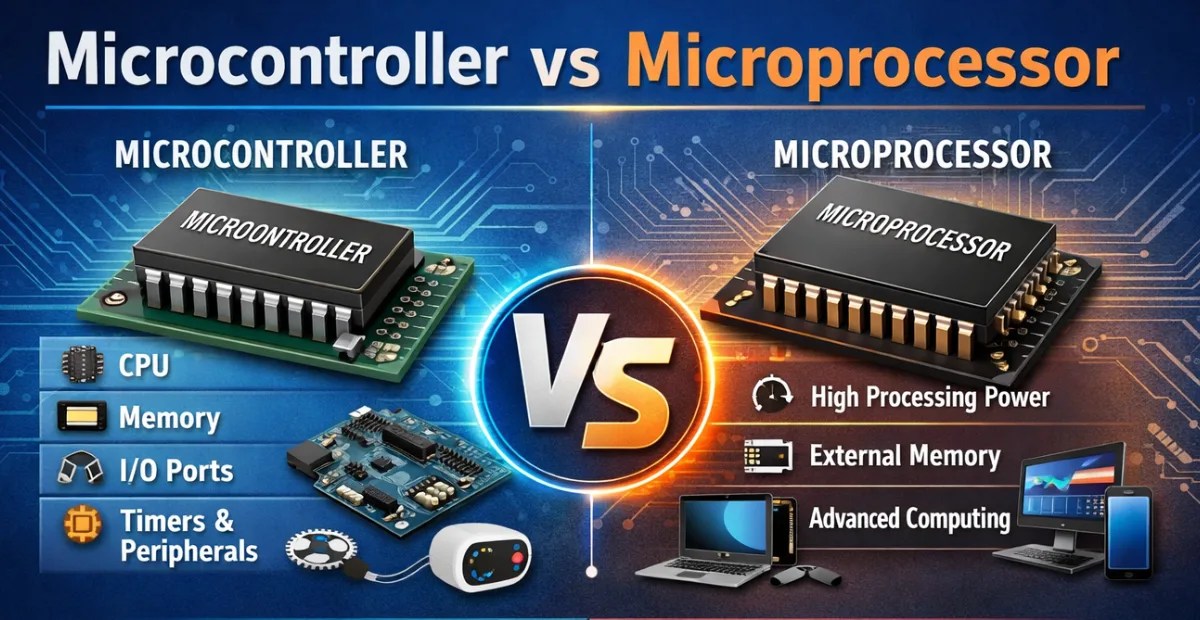
Introduction: The Chips That Power the Digital World
Every electronic device you interact with – from the smartphone in your pocket to the engine control unit in your car – runs on one of two fundamental types of computing chips: a microcontroller or a microprocessor. These two components are the building blocks of modern electronics, yet they are designed for fundamentally different purposes and environments.
For engineering students and embedded systems beginners, the distinction between a microcontroller vs microprocessor is one of the first and most important concepts to master. Get it right, and every subsequent hardware design decision becomes clearer. Get it wrong, and you risk choosing the wrong component for your project – leading to wasted cost, unnecessary complexity, or a product that simply does not work as intended.
This guide explains both components from the ground up, compares them across every important dimension, and gives you a practical framework for choosing the right one for any embedded application.
What Is a Microcontroller?
A microcontroller (MCU) is a compact, self-contained integrated circuit that combines a CPU, memory, and programmable input/output peripherals all on a single chip. It is specifically designed to execute a dedicated control function within an embedded system.
Think of a microcontroller as a complete mini-computer on a single chip – purpose-built, resource-optimized, and ready to interface directly with the physical world through sensors, buttons, motors, and displays.
Microcontroller Architecture
The internal architecture of a microcontroller integrates several subsystems on one die:
CPU (Central Processing Unit) The processor core executes firmware instructions. Most modern MCUs use RISC (Reduced Instruction Set Computing) architectures for efficient instruction execution. Clock speeds typically range from 8 MHz to 480 MHz depending on the MCU family.
Memory MCUs integrate two types of memory on-chip:
- Flash memory – Non-volatile storage for program code (firmware). Ranges from 4KB to several MB
- SRAM – Volatile RAM for runtime variables and stack. Ranges from 512 bytes to several MB
- EEPROM – Small non-volatile memory for configuration and calibration data
Input/Output Ports (GPIO) General-purpose I/O pins allow the MCU to read digital inputs (buttons, switches) and control digital outputs (LEDs, relays). Most MCUs provide 8 to 100+ configurable GPIO pins.
Timers and Peripherals On-chip peripherals eliminate the need for external components:
- Timers/PWM – Precise time measurement and motor speed control
- UART, SPI, I2C – Serial communication interfaces for connecting external devices
- ADC (Analog-to-Digital Converter) – Reads analog sensor signals
- USB, CAN, Ethernet – Advanced connectivity on higher-end MCUs
- Watchdog Timer – Automatically resets the system if firmware hangs
Popular Microcontroller Examples
- Arduino (ATmega328P / AVR) – The most popular beginner embedded platform worldwide
- STM32 (ARM Cortex-M) – Industry-standard MCU family by STMicroelectronics
- PIC (Microchip Technology) – Widely used in industrial and automotive applications
- ESP32 (Espressif) – Low-cost MCU with integrated Wi-Fi and Bluetooth for IoT
- nRF52840 (Nordic Semiconductor) – Bluetooth 5.0 MCU for wearables and IoT devices
- RP2040 (Raspberry Pi) – Dual-core ARM Cortex-M0+ MCU for maker projects
What Is a Microprocessor?
A microprocessor (MPU) is a powerful CPU chip that contains only the processing core – without integrated memory or peripherals. It is designed for general-purpose, high-performance computing where processing power and flexibility matter more than integration and power efficiency.
Think of a microprocessor as the brain of a computer that requires an entire ecosystem of external components – RAM, storage, power management ICs, and peripheral controllers – to function as a complete system.
Microprocessor Architecture
CPU Core(s) Modern microprocessors contain multiple high-performance CPU cores running at clock speeds from 1 GHz to over 5 GHz. They implement complex superscalar pipelines, out-of-order execution, branch prediction, and speculative execution to maximize instruction throughput.
Cache Memory Since microprocessors use external RAM, they include multi-level on-chip cache (L1, L2, L3) to reduce memory access latency. Cache sizes range from kilobytes (L1) to tens of megabytes (L3).
External Memory Interface Microprocessors connect to external DRAM (DDR4, DDR5, LPDDR5) via a high-speed memory bus. Modern systems pair microprocessors with gigabytes of RAM to support complex operating systems and applications.
Bus Interface and Peripherals Microprocessors connect to peripherals through external chipsets and controller ICs via buses like PCIe, USB, SATA, and HDMI. Unlike MCUs, none of these peripherals are integrated on the processor die itself.
Popular Microprocessor Examples
- Intel Core i9 / i7 / i5 – Desktop and laptop processors for personal computing
- AMD Ryzen series – High-performance computing and gaming
- ARM Cortex-A series – Smartphone and embedded Linux processors (used in Apple A-series, Qualcomm Snapdragon)
- Apple M-series (M1, M2, M3) – High-efficiency ARM-based processors for Mac computers
- NVIDIA Tegra – Embedded application processors for automotive and AI applications
- Qualcomm Snapdragon – Mobile application processors for Android smartphones
Key Differences Between Microcontroller vs Microprocessor
| Feature | Microcontroller (MCU) | Microprocessor (MPU) |
|---|---|---|
| Integration | CPU + RAM + Flash + Peripherals on one chip | CPU core only; external RAM and peripherals needed |
| Architecture | Harvard or Modified Harvard | Von Neumann (typically) |
| Processing Power | Low to moderate (8 MHz – 480 MHz) | Very high (1 GHz – 5+ GHz, multi-core) |
| RAM | KB range (512B – 8MB on-chip) | GB range (external DDR RAM) |
| Program Storage | On-chip Flash (KB to MB) | External storage (SSD, eMMC, GB to TB) |
| Operating System | Bare-metal or lightweight RTOS | Full OS (Windows, Linux, Android) |
| Power Consumption | Very low (µW to mW range) | High (watts to hundreds of watts) |
| Cost (per unit) | Very low ($0.10 – $20) | High ($50 – $1,000+) |
| PCB Complexity | Simple — minimal external components | Complex — requires RAM, power regulators, chipsets |
| Boot Time | Milliseconds | Seconds to minutes |
| Peripherals | Integrated on-chip | External via chipset/bus controllers |
| Primary Use | Dedicated embedded control | General-purpose computing |
| Programming | C, C++, Assembly (bare-metal/RTOS) | Any language via OS |
| Examples | STM32, Arduino, ESP32, PIC | Intel Core, AMD Ryzen, ARM Cortex-A |
Applications of Microcontrollers
Microcontrollers dominate applications where dedicated control, low power, small size, and low cost are the primary requirements.
Embedded Systems and Industrial Control
- PLC (Programmable Logic Controller) cores
- Motor speed and position controllers
- Industrial sensor nodes with RS485/Modbus communication
- CNC machine tool controllers
IoT Devices
- Smart energy meters and utility monitoring
- Environmental sensors (temperature, humidity, CO2)
- Smart home devices – locks, switches, thermostats
- Asset tracking and fleet management nodes
- Agricultural soil moisture monitoring systems
Automotive Systems
- Engine Control Units (ECUs) for fuel injection and ignition
- ABS (Anti-lock Braking System) controllers
- Airbag deployment systems
- Body control modules – windows, mirrors, lighting
- EV battery management systems (BMS)
Consumer Electronics and Home Appliances
- Washing machine and dishwasher control panels
- Microwave oven timing and power control
- Digital thermometers and weighing scales
- Remote controls and universal remotes
- Wireless earbuds with touch control and audio DSP
Medical Devices
- Blood glucose meters
- Portable pulse oximeters and ECG monitors
- Infusion pump controllers
- Hearing aids and cochlear implant processors
Applications of Microprocessors
Microprocessors excel where maximum processing power, multitasking, and complex software are required.
Personal Computers and Laptops
Intel Core and AMD Ryzen processors power desktop and laptop computers running Windows, macOS, and Linux for productivity, creative work, and gaming. Modern CPUs integrate 4 to 24 cores for parallel multi-threaded workloads.
Smartphones and Tablets
ARM Cortex-A based application processors (Apple A17, Qualcomm Snapdragon 8 Gen 3) run mobile operating systems managing thousands of concurrent processes, GPU rendering, AI inference, and radio communications simultaneously.
Server and Cloud Computing
Intel Xeon and AMD EPYC processors power data centers running millions of virtual machines, containerized applications, and AI training workloads. Server processors scale to 96+ cores with terabytes of RAM support.
High-Performance and Edge AI Computing
NVIDIA Jetson (ARM + GPU) and Intel Core Ultra processors bring high-performance AI inference to edge applications including autonomous vehicles, robotics, and smart cameras running complex neural networks in real time.
Embedded Linux Systems
ARM Cortex-A processors on platforms like Raspberry Pi, BeagleBone, and NVIDIA Jetson Nano run full Linux distributions for applications requiring complex software stacks, network servers, computer vision, and high-bandwidth data processing.
Advantages and Disadvantages of Microcontrollers
Advantages
- All-in-one integration – No external RAM, storage, or peripheral ICs needed for basic designs
- Ultra-low power – Sleep currents in the nanoamp range enable years of battery operation
- Instant startup – Executes firmware in milliseconds with no OS boot sequence
- Low cost – Entry-level MCUs cost less than $1 in volume
- Simple PCB design – Minimal supporting components reduce board complexity
- Real-time determinism – Precise interrupt response times for safety-critical control
- Long-term availability – Industrial MCUs maintained in production for 10–20 years
Disadvantages
- Limited processing power – Cannot run complex algorithms, high-resolution video, or large AI models
- Small memory – KB-scale RAM limits data structures and program complexity
- No rich OS – Running Linux or Windows requires external processor
- Development complexity – Bare-metal firmware requires deep hardware knowledge
- Limited debug tools – Fewer software-level debug options compared to application development
Advantages and Disadvantages of Microprocessors
Advantages
- Massive processing power – Multi-core GHz processors handle any computational workload
- Full OS support – Runs Linux, Windows, Android with complete software ecosystems
- Virtually unlimited memory – Supports GB to TB of external RAM and storage
- Rich software ecosystem – Any programming language, framework, or library available
- Highly flexible – Reprogrammable for any application without hardware changes
- Advanced debugging – Full IDE support, profilers, debuggers, and OS-level diagnostics
Disadvantages
- High power consumption – Requires watts to hundreds of watts; impractical for battery devices
- High cost – Processor alone costs $50 to $1,000+; full system board much more
- Complex PCB design – Requires high-speed RAM routing, power management, and thermal management
- Slow startup – OS boot takes seconds to minutes
- Overkill for simple tasks – Using a microprocessor to blink an LED wastes 99.9% of its capability
Microcontroller vs Microprocessor – Which One Should You Choose?
Choose a Microcontroller when:
- Your application performs a single dedicated control function
- You need battery operation lasting months or years
- Cost per unit must be minimized (consumer products, IoT sensors)
- Real-time response to hardware events is required
- PCB space and component count must be minimized
- You are building: a sensor node, motor controller, IoT device, automotive ECU, or home appliance
Choose a Microprocessor when:
- Your application requires complex software – web server, database, neural network
- You need a full operating system (Linux, Android, Windows)
- Processing power for multimedia, AI inference, or parallel computing is required
- The system requires gigabytes of RAM and terabytes of storage
- You are building: a smart TV, industrial PC, robotics controller, autonomous vehicle platform, or edge AI system
The hybrid reality: Many modern products use both. A Tesla vehicle, for example, uses an AMD Ryzen microprocessor for the central infotainment and AI computer while using dozens of ARM Cortex-M microcontrollers throughout the vehicle for individual subsystem control (braking, steering, battery management). The MCU handles real-time control; the MPU handles intelligence and connectivity.
Future of Microcontroller vs Microprocessor in Embedded Systems
The boundary between Microcontroller vs Microprocessor is becoming increasingly blurred as semiconductor technology advances.
TinyML and AI on Microcontrollers
Frameworks like TensorFlow Lite for Microcontrollers and Edge Impulse now enable neural network inference on ARM Cortex-M4 and M7 MCUs with as little as 256KB RAM. Keyword spotting, gesture recognition, and predictive maintenance models run entirely on MCUs – no microprocessor required.
RISC-V Disruption
The open-source RISC-V instruction set is reshaping both Microcontroller vs Microprocessor markets. From the ultra-low-cost ESP32-C3 (RISC-V MCU) to high-performance SiFive server processors, RISC-V is enabling custom silicon design without proprietary licensing fees, democratizing chip development globally.
Heterogeneous Computing
Modern embedded SoCs increasingly combine MCU-class cores (for real-time control) with MPU-class cores (for application processing) on a single chip. The STM32MP1 (ARM Cortex-M4 + Cortex-A7), i.MX RT crossover MCUs, and Qualcomm IoT chips exemplify this trend – delivering real-time control and complex software in one package.
Chiplets and Advanced Packaging
Advanced packaging technologies allow Microcontroller vs Microprocessor dies to be combined in a single package with high-bandwidth interconnects – further blurring the line between the two categories and enabling unprecedented levels of integration for embedded AI and autonomous systems.
Conclusion
The microcontroller vs microprocessor debate is not really about which component is better – it is about understanding which tool is right for a specific job. Microcontrollers deliver integration, efficiency, real-time control, and low cost for dedicated embedded applications. Microprocessors deliver raw computational power, software flexibility, and connectivity for complex computing tasks.
Every embedded systems engineer needs fluency in both worlds. Mastering microcontroller firmware gives you direct hardware control and real-time capability. Understanding microprocessor-based Linux systems gives you software richness and computational power. Together, these skills cover virtually the entire embedded systems landscape.
Frequently Asked Questions (FAQ)

Discover more from Piest Systems - Embedded Systems Training Institute in Bangalore
Subscribe to get the latest posts sent to your email.