
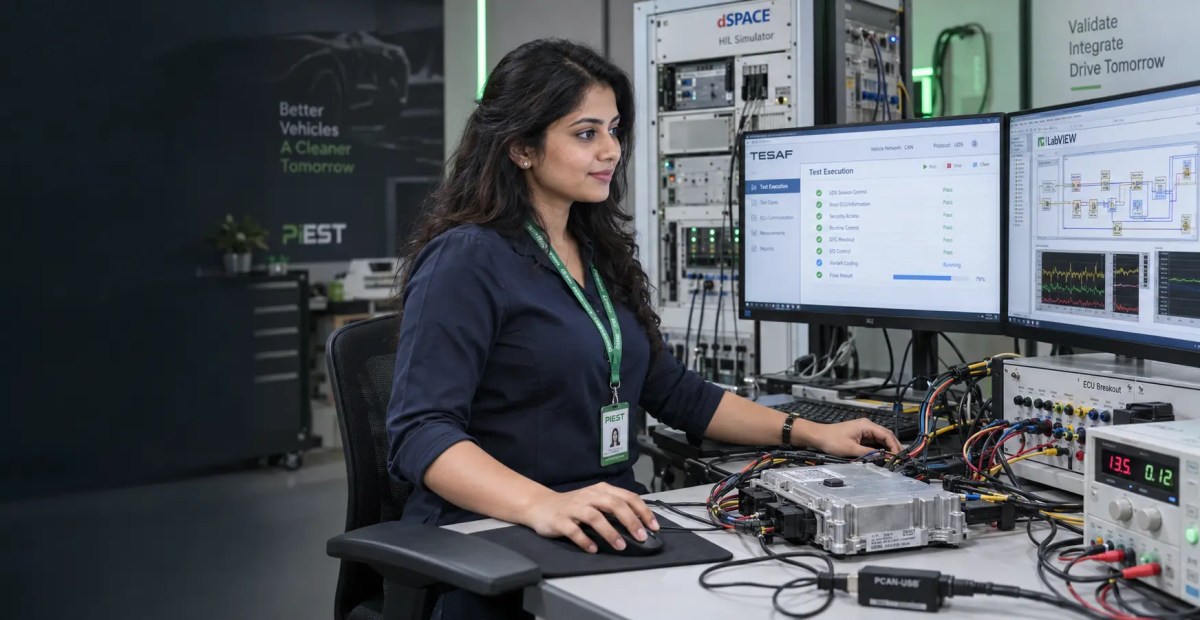
Automotive Python Course for ECU Simulation & Test Automation
Build practical automotive Python scripting skills for CAN, CAN FD, ISO-TP, UDS, LIN and DoIP. Learn ECU simulation, Python ECU testing, pytest and Robot Framework automotive testing through guided work with TESAF, supported interfaces and real ECU hardware.
Choose the Training Mode That Works for You
The same automotive Python learning path is available through live instruction, classroom training, fully recorded learning and a flexible hybrid model.
Live Online Training
Attend instructor-led sessions from anywhere, ask questions in real time and complete guided practical exercises through remote laboratory access. Session replays or supporting recorded lessons are available according to the selected plan.
Offline Training
Attend classroom sessions at PiEST Systems and work directly with trainers, automotive ECUs, communication hardware and available laboratory tools.
Fully Recorded Course
Learn at your own pace through structured recorded lessons on the PiEduET learning platform, with access governed by the selected course plan.
Hybrid Training
Combine online learning, selected live sessions, recorded lessons and scheduled classroom or laboratory activities according to the available batch plan.
Delivery schedules, classroom availability, recording access and laboratory slots may vary by batch. Confirm the selected plan before enrolment.
Move from Manual ECU Testing to Automotive Test Automation
The Automotive Python Course by PiEST Systems is designed for freshers, manual testers, HIL engineers, diagnostic engineers and experienced automotive professionals who want to automate vehicle communication and ECU validation. This focused Automotive Python Course turns programming concepts into repeatable engineering workflows.
Automotive Python scripting is taught from the fundamentals before progressing to CAN, DBC processing, ISO-TP, UDS diagnostics, ECU simulation, pytest and Robot Framework automotive testing. The Premium track adds CAN FD, supported CAN XL workflows, LIN, LIN-TP, Ethernet, TCP, UDP and DoIP.
Every major topic connects to Python ECU testing: configure communication, stimulate an ECU or simulated node, observe the response, apply an assertion and retain traceable evidence. That makes the Automotive Python Course useful for both learning and day-to-day automotive test automation.
This is a focused automation program. It does not replace the separate six-month, job-oriented HIL Testing Course that covers the complete HIL engineering workflow and placement-assistance program.
What You Will Build Through Automotive Python Scripting
- Python CAN transmitter, receiver and trace logger
- DBC-based signal encoder and decoder
- ISO-TP and UDS diagnostic client
- Configurable Python ECU simulator for ECU simulation
- pytest automated validation framework
- Robot Framework automotive testing suite
- Automated logs and HTML test reports
Automotive Python Course at a Glance
| 🎓 Course | Automotive Python Course for ECU Simulation and Automotive Test Automation |
| 🌱 Essential track | 1 month: Python, CAN, DBC, ISO-TP/CAN-TP and UDS automation |
| 🚀 Premium track | 2 months: Essential topics plus CAN FD, supported CAN XL, LIN, LIN-TP, Ethernet, TCP, UDP, DoIP, ECU simulation, pytest and Robot Framework |
| 🗓️ Complete track | 20 instructor-led sessions and 30 training hours |
| 🧭 Delivery | Live online, offline classroom, fully recorded and hybrid options |
| ▶ Recorded learning | Structured self-paced lessons through the PiEduET platform |
| 👥 Batch size | Maximum 10 learners in instructor-led batches |
| 🧪 Practical access | TESAF-powered automotive Python scripting, ECU simulation, simulated nodes, real ECUs and supported automotive hardware |
| 💬 Support | 3 months of doubt-clearing support from the date of joining |
| 🗣️ Language | English |
| 👨🏫 Trainers | Automotive professionals with 15–20 years of domain experience |
| 📜 Certificate | Track-specific completion certificate, subject to applicable requirements |
| 💰 Fee | Contact PiEST Systems for current fees and batch availability |
Choose Your Automotive Python Course Track
Start with core CAN and UDS Python ECU testing or complete the advanced multi-protocol, ECU simulation and automotive test automation path.
| Feature | 🌱 Essential — 1 Month | 🚀 Premium — 2 Months |
|---|---|---|
| Python fundamentals | Included | Included |
| CAN and DBC automation | Included | Included |
| ISO-TP/CAN-TP and UDS | Included | Advanced coverage |
| CAN FD and supported CAN XL | Not included | Included |
| LIN, LIN-TP and diagnostics over LIN | Not included | Included |
| Ethernet, TCP, UDP and DoIP | Not included | Included |
| Python ECU simulation | Basic diagnostic simulation | Advanced multi-protocol simulation |
| pytest | Basic automated checks | Reusable test framework |
| Robot Framework automotive testing | Overview | Keyword-driven automation |
| TESAF practical access | Essential exercises | Extended exercises |
| Best for | Beginners and CAN/UDS learners | Test engineers and automation professionals |
How Automotive Python Scripting Becomes ECU Test Evidence
Students learn a layered automotive test automation approach that keeps readable test cases separate from protocol communication, ECU simulation and hardware control.
Robot Framework Automotive Testing
Readable keywords, test suites, tags, verdicts, logs and reports.
Python Libraries
CAN, ISO-TP, UDS, LIN, DoIP and reusable tool adapters.
TESAF & Hardware
Communication channels, test execution, simulation and remote access.
Python ECU Testing
Automated response checks, trace evidence and HTML test reports.
Automotive Python Course Curriculum
Open each module to review the learning topics. Essential students complete the core automotive Python scripting path; Premium students continue through advanced protocols, ECU simulation and test frameworks.
Module 1 – Python Fundamentals for Automotive Engineers
- Variables, types and operators
- Conditions and loops
- Lists, tuples and dictionaries
- Functions and modules
- Classes and object-oriented programming
- Exceptions and file handling
- JSON and CSV configuration
- Binary, hexadecimal and bitwise operations
Module 2 – Automotive Communication Fundamentals
- ECUs, sensors and actuators
- Vehicle network architecture
- Messages, signals and diagnostics
- Physical and simulated ECUs
- Manual vs automated testing
- SIL and HIL automation overview
Module 3 – CAN and DBC Automation
- CAN frames and arbitration
- Standard and extended IDs
- Send, receive and filter
- Periodic communication
- PCAN and TESAF integration
- DBC encoding and decoding
- Signal scaling and byte order
- Trace logging and validation
Module 4 – ISO-TP/CAN-TP
- Single and multi-frame messages
- First and Consecutive Frames
- Flow Control
- Block Size and Separation Time
- Addressing modes
- Timing and timeout handling
Module 5 – UDS Diagnostic Automation
- Diagnostic sessions and timing
- Positive and negative responses
- 0x10, 0x11, 0x14 and 0x19
- 0x22, 0x27, 0x28 and 0x2E
- 0x2F, 0x31 and 0x3E
- DIDs, DTCs and NRCs
- Assertions and invalid requests
- Diagnostic logging
Module 6 – CAN FD, CAN XL and LIN Automation
- CAN FD messages and BRS
- Supported CAN XL workflows
- LIN master and slave concepts
- Schedules and diagnostic frames
- LIN Transport Protocol
- Diagnostics over LIN
Module 7 – Ethernet, TCP, UDP and DoIP
- IP and socket fundamentals
- TCP and UDP clients
- Connection and retry handling
- DoIP vehicle discovery
- Routing activation
- UDS over DoIP
Module 8 – Python ECU Simulation
This ECU simulation module turns protocol knowledge into configurable virtual ECU behaviour for repeatable Python ECU testing.
- Periodic and event-driven messages
- Signal and state simulation
- Diagnostic request handling
- Simulated DIDs and DTCs
- Delayed, missing and invalid responses
- Multi-node simulation
- CAN and DoIP ECU simulation
- Communication fault injection
Module 9 – pytest Automation
- Test discovery and assertions
- Fixtures and parameterization
- Setup and teardown
- Positive and negative testing
- Data-driven test execution
- Regression suites
Module 10 – Robot Framework Automotive Testing
Robot Framework automotive testing adds a readable keyword layer above reusable Python libraries and TESAF actions.
- Test cases, variables and keywords
- Tags, templates and resources
- Custom Python keyword libraries
- CAN and UDS keywords
- Data-driven diagnostic testing
- Setup and teardown
- Selective execution with tags
- Report.html, log.html and output.xml
Module 11 – TESAF Integration and Remote ECU Testing
- TESAF channel configuration
- Python and Robot integration
- Real ECU communication
- Remote test execution
- Trace collection
- Automated verdicts and reports
Automotive Test Automation Projects
Turn Automotive Python Course knowledge into demonstrable automotive Python scripting, ECU simulation and Python ECU testing solutions.
CAN Communication Tool
Transmit, receive, filter and log CAN messages using Python and supported interfaces.
DBC Signal Automation
Encode physical values, decode raw payloads and validate automotive signals.
UDS Diagnostic Tester
Automate diagnostic sessions, DIDs, DTCs, routines, timing and negative responses.
Python ECU Simulator
Create configurable communication, state and diagnostic-response behaviour for realistic ECU simulation.
Robot Test Suite
Apply Robot Framework automotive testing to readable keywords, suites, verdicts, execution logs and reports.
Real ECU Capstone
Execute an end-to-end automated validation workflow using TESAF and real hardware.
Automotive Python Course Lab Experience
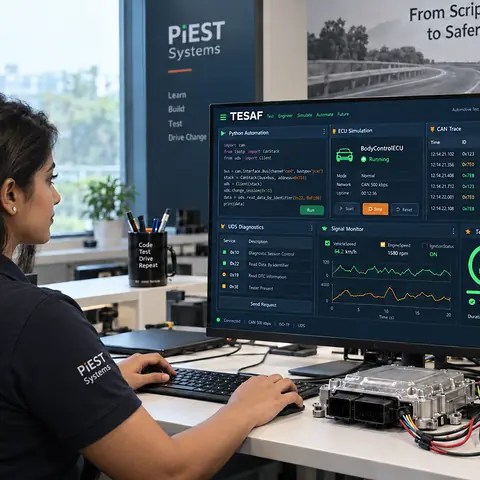
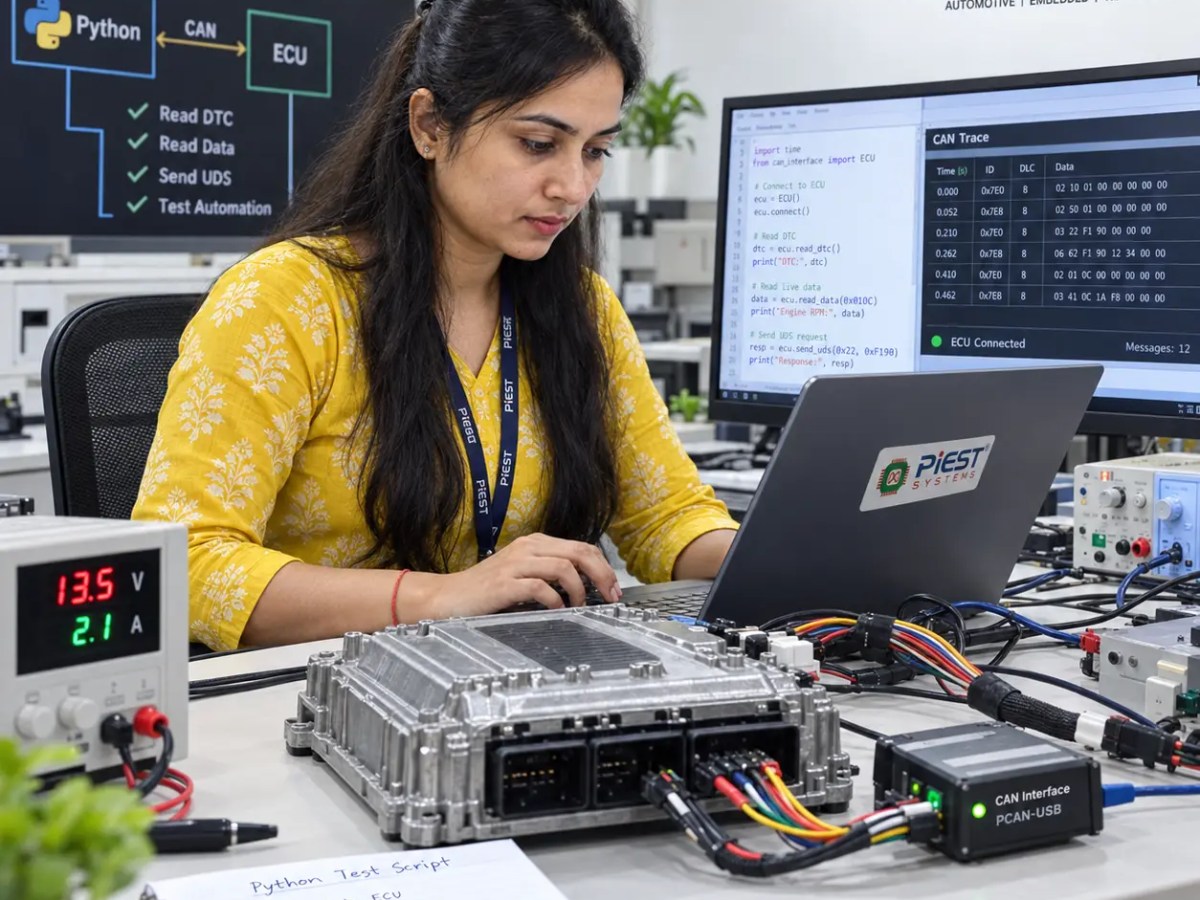
Explore a professional TESAF-based laboratory environment illustrating how automotive Python scripting, ECU simulation, diagnostic automation and real ECU validation work together.

Who Should Join This Automotive Python Course?
Manual Testers
Move from repetitive manual ECU checks to Python ECU testing and reusable automated validation.
HIL Engineers
Add Python and Robot Framework automation to existing HIL knowledge.
Diagnostic Engineers
Automate UDS services, timings, DIDs, DTCs and negative-response testing.
ECU Validation Teams
Build structured automotive test automation, regression evidence and automated reports.
Fresh Graduates
Start from Python fundamentals and progress into automotive Python scripting and automation.
CAPL Users
Complement tool-specific scripting with portable Python automation skills.
Why PiEST Systems?
PiEST Systems is an automotive and embedded-systems startup involved in engineering services, product development and professional training—not only classroom instruction.
Learners benefit from the same ecosystem that includes TESAF, AutoPie Studio, ECU software development, diagnostic validation, HIL testing and automotive engineering services.
- Python taught from the fundamentals
- Real ECU and automotive hardware access
- TESAF and applicable licensed tools
- pytest and Robot Framework automotive testing
- Maximum 10 learners in live batches
- 15–20 years of trainer experience
- Live, classroom, recorded and hybrid options
- Three months of doubt-clearing support
Automotive Python Course FAQs
Do I need Python knowledge before joining the Automotive Python Course?
No. The Essential Automotive Python Course track starts with Python fundamentals before moving into automotive Python scripting, communication and diagnostic automation.
Which training modes are available?
PiEST Systems offers live online, offline classroom, fully recorded and hybrid training options. Availability and schedules depend on the selected batch and plan.
How does the fully recorded course work?
Learners access structured recorded lessons through the PiEduET learning platform and progress at their own pace during the applicable access period.
Are recordings available with live online training?
Live online plans may include session replays or supporting recorded lessons through PiEduET. Recording availability and the access period are confirmed for the selected batch before enrolment.
What does hybrid training include?
Hybrid training combines recorded lessons with selected live online sessions and scheduled classroom or practical laboratory activities, depending on the available plan.
Is Robot Framework automotive testing included?
Yes. The Premium track covers Robot Framework automotive testing fundamentals, keyword-driven automotive tests, custom Python keyword libraries, test suites, logs and HTML reports.
Will I practise Python ECU testing with real hardware?
Selected Python ECU testing exercises use real automotive ECUs, TESAF and supported communication hardware through classroom or scheduled remote-laboratory access.
Does the Automotive Python Course include ECU simulation?
Yes. ECU simulation progresses from basic diagnostic behaviour to configurable CAN and DoIP nodes, DIDs, DTCs, timing responses and communication faults. Practical availability depends on the selected Automotive Python Course track and lab configuration.
How is automotive test automation taught?
Automotive test automation is taught as a complete workflow: configure the interface, stimulate the ECU, capture responses, validate expected behaviour, collect traces and produce reports. Python, pytest and Robot Framework automotive testing are used at complementary levels.
Is this the complete HIL Testing Course?
No. This Automotive Python Course is focused on automotive Python scripting, ECU simulation and automotive test automation. PiEST Systems provides a separate six-month job-oriented HIL Testing Course with broader HIL engineering coverage and placement assistance under its applicable policy.
Is placement assistance included?
Dedicated placement assistance is associated with the separate six-month HIL Testing Course. This one- or two-month program is focused specifically on skill development in automotive Python automation.
What is the course fee?
Contact PiEST Systems for current Essential and Premium fees, delivery-mode options and upcoming batch availability.
Ready to Join the Automotive Python Course?
Choose live online, offline classroom, fully recorded or hybrid training and start building automotive Python scripting, ECU simulation and automotive test automation skills with real automotive tools.
Email: info@piestsystems.com • Bengaluru, India • Online and offline availability subject to the current batch schedule.
