
If you are an embedded engineer wondering what the single highest-leverage skill addition to your career could be in 2026 – the answer, for most engineers, is Linux device driver training. While many embedded engineers remain comfortable working only at the bare-metal microcontroller level, the industry has been quietly shifting toward Linux-based embedded platforms for over a decade – and the engineers who can write kernel-level drivers are now among the scarcest and highest-paid in the country.
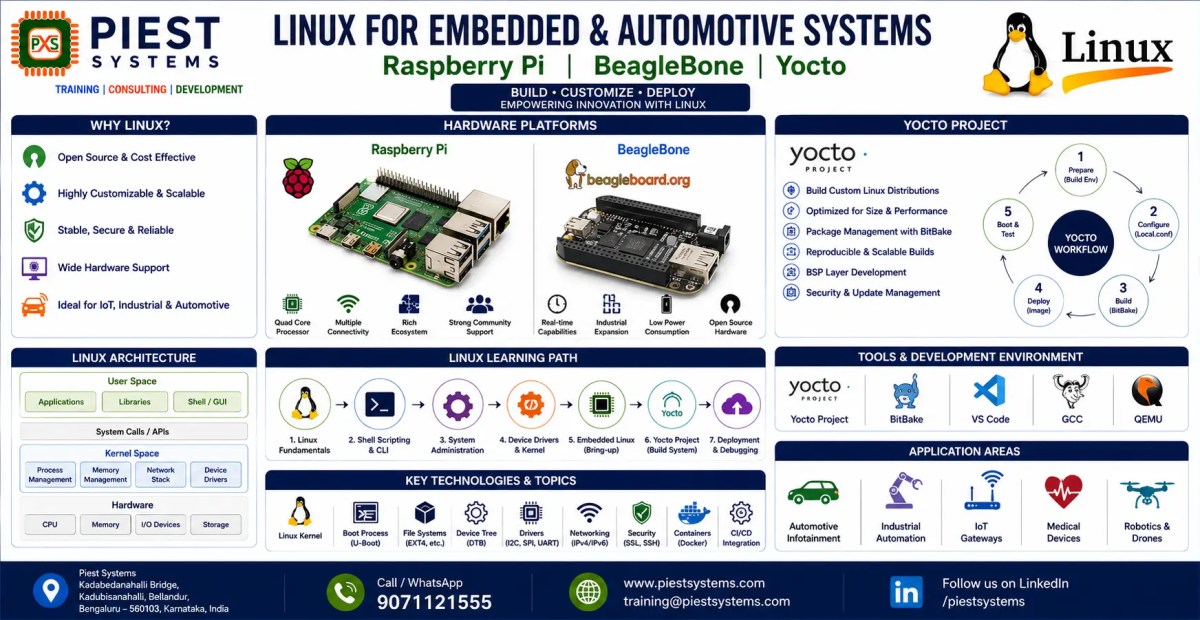
Every smart device with a screen, a network connection, or significant processing power – automotive infotainment systems, industrial gateways, networking equipment, medical imaging devices, and telecom infrastructure – runs embedded Linux. And every one of these devices needs engineers who can write, debug, and maintain the device drivers that let Linux talk to custom hardware.
This complete guide covers everything – what Linux device drivers are, how the Linux kernel architecture works, the real hands-on skills covered in embedded Linux course training, career scope, salary expectations, and how Piest Systems’ Linux kernel training Bangalore program builds the depth that genuinely differentiates engineers in interviews.
What Is a Linux Device Driver?
A Linux device driver is kernel-level software that allows the Linux operating system to communicate with a specific piece of hardware. Without device drivers, the Linux kernel – no matter how powerful – cannot do anything useful with the physical world. It cannot read a sensor, control a motor, send data over a network interface, or display anything on a screen.
Think of the kernel as a highly capable manager that knows how to schedule tasks, manage memory, and organise files – but has no idea how to physically operate a GPIO pin, an I2C sensor, or a custom FPGA interface. The device driver is the translator that sits between the kernel’s generic interfaces and the specific hardware registers of your device.
Engineers who complete Linux device driver training learn to write this translation layer – code that runs inside the kernel, with direct access to hardware registers, interrupts, and memory-mapped I/O, while correctly following the kernel’s internal APIs and synchronisation rules.
This is fundamentally different from application-level programming. A bug in a user-space application crashes that application. A bug in a kernel-level device driver can crash the entire system – which is exactly why engineers with this skill are so valuable, and why Linux device driver training has such a steep but rewarding learning curve.
Why Linux Device Driver Training Matters More Than Ever in 2026
The case for Linux device driver training has never been stronger. Here is what is driving demand:
Embedded Linux Is Everywhere: Automotive infotainment and telematics units, industrial PLCs and gateways, networking routers and switches, smart TVs, medical imaging equipment, and 5G base stations all run embedded Linux. Every one of these product categories needs custom drivers for the specific sensors, displays, and communication interfaces they use.
The Skill Gap Is Real: Most embedded engineers in India are trained on bare-metal microcontroller programming – Arduino, STM32, and similar platforms. Very few have hands-on embedded Linux course experience with real kernel module development. This scarcity is precisely why Linux kernel engineers command such a premium.
Automotive Is Moving to Linux: As vehicles become “Software Defined Vehicles,” automotive infotainment, telematics, and even some ADAS domain controllers are increasingly running Linux (and Android Automotive, which is Linux-based) rather than bare-metal RTOS. Automotive companies are actively hiring engineers with Linux driver development career backgrounds to support this transition.
Industrial IoT Gateways: Every industrial IoT deployment needs a gateway device that bridges field-level sensors (often using custom protocols) to cloud connectivity. These gateways run embedded Linux, and someone has to write the drivers that connect the gateway’s hardware interfaces to the Linux networking and IoT stack.
Telecom Infrastructure: 5G base stations, network function virtualisation platforms, and telecom edge computing devices are built on Linux. Linux system engineer training is a direct pathway into telecom infrastructure roles – one of the highest-paying segments in Indian tech.
Linux Kernel Architecture: What Every Driver Developer Must Understand
Before writing a single line of driver code, a solid Linux device driver training program builds your understanding of how the kernel itself is organised. Here is the architecture you need to internalise:
User Space vs Kernel Space
Linux strictly separates user space (where applications run, with restricted privileges) from kernel space (where the OS core and device drivers run, with full hardware access). Applications communicate with drivers through system calls – a controlled gateway that prevents user programs from directly touching hardware.
Understanding this boundary – and why it exists – is the conceptual foundation of all embedded Linux course training. Every driver you write must respect this boundary correctly, or you risk security vulnerabilities and system instability. For deeper technical reference, the official Linux kernel driver API documentation is the authoritative source that working kernel engineers consult daily.
The Three Main Driver Types
Character Drivers: Handle devices that transfer data as a stream of bytes – sensors, serial ports, and most custom hardware interfaces. Character drivers are the most common starting point in Linux device driver training because they map directly to simple read/write operations.
Block Drivers: Handle devices that store data in fixed-size blocks – storage devices like eMMC, SD cards, and SSDs. Block drivers interact with the kernel’s filesystem layer and block I/O scheduler.
Network Drivers: Handle network interface cards – Ethernet controllers, Wi-Fi chipsets, and custom networking hardware. Network drivers interface with the kernel’s networking stack (sockets, TCP/IP).
Kernel Modules: Loadable Driver Code
Most Linux drivers are written as Loadable Kernel Modules (LKMs) – compiled .ko files that can be inserted into and removed from a running kernel using insmod and rmmod, without rebooting the system. This is one of the first practical skills taught in any genuine Linux kernel training Bangalore program – write a minimal kernel module, compile it against the kernel headers, load it, observe it in dmesg, and unload it cleanly.
The Device Tree
On embedded Linux systems like the Raspberry Pi and BeagleBone, hardware configuration is described in a Device Tree – a data structure that tells the kernel what hardware exists on the board (which I2C devices are present, which GPIO pins are used for what, memory addresses of peripherals) without hardcoding this information into the kernel itself. Modifying and understanding device tree source files (.dts) is essential for any engineer doing real Linux driver development career work on custom hardware.
Communication Interfaces You Will Master in Linux Device Driver Training
A core part of any practical Linux device driver training program is writing drivers for the standard communication interfaces that connect microcontrollers and embedded processors to peripherals:
GPIO (General Purpose Input/Output)
The simplest and most fundamental interface. You will learn to write drivers that configure GPIO pins as inputs or outputs, handle GPIO interrupts (for buttons, motion sensors, and alarm signals), and expose GPIO control safely to user space through the kernel’s GPIO subsystem.
I2C (Inter-Integrated Circuit)
A two-wire bus protocol used by countless sensors – temperature, accelerometers, EEPROMs, and real-time clocks. Linux device driver training covers writing I2C client drivers that register with the kernel’s I2C subsystem, communicate with sensor registers, and expose sensor data to user space.
SPI (Serial Peripheral Interface)
A faster four-wire protocol used for displays, flash memory, and high-speed ADCs/DACs. You will learn to write SPI drivers that handle the kernel’s SPI framework – transferring data buffers between the kernel and SPI peripherals with correct timing and chip-select handling.
UART (Universal Asynchronous Receiver/Transmitter)
Serial communication drivers for debug consoles, GPS modules, and legacy serial peripherals – covering the kernel’s TTY (teletype) subsystem and serial driver framework.
Interrupt Handling
Every real device driver eventually needs to respond to hardware interrupts – a button press, a data-ready signal from a sensor, or a completed DMA transfer. Embedded Linux course training covers requesting interrupts, writing interrupt handlers, and the critical distinction between hard interrupt context and deferred work (tasklets, workqueues).
Memory-Mapped I/O and DMA
Advanced Linux driver development career topics include mapping physical hardware register addresses into kernel virtual memory space, and using Direct Memory Access (DMA) for high-throughput data transfer without CPU involvement – essential for drivers handling cameras, audio codecs, and high-speed storage.
Tools and Hardware Used in Linux Device Driver Training at Piest Systems
A genuine Linux kernel training Bangalore program is built entirely around hands-on practice on real embedded Linux hardware — not virtual machines pretending to be embedded systems.
Raspberry Pi and BeagleBone – Real Embedded Linux Boards
Training is conducted on real Raspberry Pi and BeagleBone boards – two of the most widely used ARM-based single-board computers in embedded Linux development. The Raspberry Pi gives trainees a powerful, well-documented platform for general kernel module and GPIO/I2C/SPI driver development, while the BeagleBone’s exposed processor pins and industrial-grade design make it ideal for low-level peripheral interfacing and device tree customisation work.
You write, compile, and load real kernel modules on both boards, then verify behaviour by physically observing connected sensors, LEDs, and peripherals respond – exactly the workflow used in real embedded Linux product development.
Yocto Project – Industry-Standard Build System
Linux device driver training at Piest Systems includes hands-on use of the Yocto Project – the industry-standard build system used by virtually every major embedded Linux product company to create custom Linux distributions for their hardware. You will learn how Yocto layers, recipes, and bitbake work together to build a custom root filesystem and kernel image for Raspberry Pi and BeagleBone targets.
Yocto experience is one of the most frequently requested skills in embedded Linux job postings – and one of the least commonly taught in entry-level training programs. Covering it hands-on at Piest Systems gives embedded Linux course graduates a direct competitive advantage in interviews at semiconductor, automotive, and industrial IoT companies.
Cross-Compilation Toolchain
Since Raspberry Pi and BeagleBone boards use ARM processors while development is done on a PC, Linux device driver training teaches you to set up and use a cross-compilation toolchain – including the toolchains generated by Yocto – compiling kernel modules on your development machine that are correctly built for the target board’s ARM architecture and matching kernel version.
Kernel Source, Headers, and Yocto Build Layers
You will work directly with kernel source trees and kernel headers matching your target board’s kernel version – learning to navigate the kernel source code, find existing driver examples to learn from, and understand how the build system (Kbuild/Makefiles) compiles modules against the correct kernel configuration. Through Yocto, you will also see how custom kernel configurations, device tree overlays, and driver modules are integrated into a complete, deployable Linux image for Raspberry Pi and BeagleBone targets.
Debugging Tools
Linux system engineer training includes hands-on use of essential kernel debugging tools – dmesg for kernel log messages, /proc and /sys filesystem inspection for runtime driver state, strace for tracing system calls from user space, and GDB-based kernel debugging techniques for more advanced troubleshooting.
Device Tree Editing and Compilation
You will edit device tree source files, compile them into device tree blobs (.dtb), and deploy them to real hardware – directly experiencing how hardware description changes affect which drivers bind to which devices at boot time.
Linux Driver Development Career: Roles and Growth Path
Completing Linux device driver training opens a career path that is distinctly different from – and often more lucrative than – general embedded firmware roles. Here is what a Linux driver development career looks like:
Junior Linux Kernel/Driver Engineer (0-2 Years)
- Writing and debugging character device drivers for sensors and simple peripherals
- Working with I2C, SPI, and GPIO drivers under senior engineer guidance
- Modifying device tree files for board-specific hardware configurations
- Debugging using
dmesg,/proc, and/sysfilesystem inspection - Building and flashing custom kernel images for target boards
Mid-Level Embedded Linux Engineer (2-5 Years)
- Designing and implementing drivers for complex peripherals – cameras, displays, audio codecs
- Working with DMA, interrupt handling, and power management frameworks
- Board support package (BSP) development and kernel configuration for new hardware platforms
- Performance optimisation and kernel-level debugging of production issues
- Mentoring junior engineers on kernel development practices
Senior Linux Kernel Engineer / BSP Architect (5+ Years)
- Leading board support package development for new product platforms
- Upstreaming driver code to mainline Linux kernel (for companies that contribute open source)
- Architecting the Linux/driver layer for entire product lines
- Working directly with silicon vendors on chip-level driver integration
- Setting kernel security, performance, and update strategy for products
Linux system engineer training that builds real competence across these levels positions engineers for roles at semiconductor companies, automotive infotainment teams, industrial IoT companies, networking equipment manufacturers, and telecom infrastructure firms — across India and internationally.
Linux Embedded Engineer Salary in India 2026
Linux kernel and device driver engineers are consistently among the highest-paid embedded specialists in India – a direct reflection of how rare genuine Linux device driver training backgrounds are in the job market.
| Experience Level | Role | Salary Range (LPA) |
|---|---|---|
| 0-2 years (with Linux driver training) | Junior Linux/Driver Engineer | ₹5 – ₹8 LPA |
| 2-5 years | Embedded Linux Engineer | ₹9 – ₹15 LPA |
| 5-10 years | Senior Linux Kernel Engineer / BSP Lead | ₹15 – ₹25 LPA |
| 10+ years | Principal Engineer / BSP Architect | ₹25 – ₹40+ LPA |
Engineers who combine Linux device driver training with automotive domain knowledge (automotive Linux/Android Automotive infotainment) or telecom infrastructure experience are positioned at the top end of these ranges, often exceeding ₹40 LPA at senior levels.
Who Should Enrol in Linux Device Driver Training?
A serious Linux device driver training program is the right investment for:
✅ Working Embedded Engineers (2-6 years) – If you have solid C and microcontroller experience but have never written kernel-level code, this is the single course that opens the door to the highest-paying embedded specialisation in the industry.
✅ ECE/CSE Graduates Targeting Product Companies – Fresh graduates who complete embedded Linux course training before job hunting differentiate themselves dramatically from the thousands of candidates with only Arduino or bare-metal microcontroller experience.
✅ Engineers Targeting Automotive Infotainment – As automotive infotainment and telematics shift to Linux and Android Automotive, Linux driver development career skills are becoming a direct requirement for automotive software roles beyond AUTOSAR.
✅ IoT Engineers Building Gateway Devices – If you are working on IoT products with Linux-based gateways, understanding how to write and debug the drivers that connect your sensors to the Linux networking stack is essential.
✅ Engineers Targeting Telecom and Networking Roles – Linux system engineer training is a direct pathway into telecom infrastructure, networking equipment, and edge computing roles – some of the highest-paying segments in Indian tech.
✅ Linux Enthusiasts Wanting to Go Professional – If you already use Linux daily and are curious about how it actually works under the hood, Linux device driver training is the natural progression from “Linux user” to “Linux kernel developer” – a career-defining transition.
What to Look for in a Linux Kernel Training Program
Not every program advertising Linux kernel training Bangalore delivers genuine kernel-level competence. Here is what to evaluate before enrolling:
Real Hardware, Real Kernel Modules
Any Linux device driver training program that does not have you compile, load, and unload real kernel modules on real hardware like Raspberry Pi or BeagleBone is not teaching you employable skills. Reading about kernel concepts is not the same as debugging a kernel module that fails to load.
Cross-Compilation and Toolchain Setup
A genuine embedded Linux course must teach you to set up a cross-compilation environment from scratch – this is a frequently underestimated skill that trips up engineers in their first weeks on the job.
Device Tree Coverage
If a program does not cover device tree editing and compilation, it is teaching outdated or incomplete content. Modern embedded ARM Linux development is built around the device tree model.
Interrupt and DMA Coverage
Surface-level Linux driver development career training stops at simple character drivers. A genuinely useful program goes further – interrupt handling, workqueues, and at least an introduction to DMA-based drivers.
Debugging Methodology
dmesg, /proc, /sys, and basic kernel debugging techniques should be taught as core skills, not afterthoughts. Linux system engineer training that does not build real debugging competence leaves you unprepared for production troubleshooting.
Industry-Experienced Trainers
Your trainer should have written and debugged real drivers for production embedded Linux products – not just academic kernel module examples. Ask specifically about their BSP or driver development project experience.
Linux Device Driver Training at Piest Systems, Bangalore
At Piest Systems, our Linux device driver training program is designed by engineers with real embedded Linux and BSP development experience. Every concept is taught hands-on, on real Raspberry Pi and BeagleBone hardware using Yocto, with the goal of building genuine kernel-level competence – not just conceptual familiarity.
What You Will Learn
- Linux kernel architecture – user space vs kernel space, system calls, kernel subsystems
- Setting up a cross-compilation toolchain for Raspberry Pi and BeagleBone targets, including Yocto-generated toolchains
- Writing, compiling, loading, and unloading Loadable Kernel Modules (LKMs)
- Character device driver development – registration, file operations, ioctl
- GPIO driver development – configuring pins, handling interrupts
- I2C client driver development – communicating with real I2C sensors
- SPI driver development – interfacing with SPI peripherals
- UART/TTY driver concepts and serial communication
- Interrupt handling – hard IRQs, tasklets, and workqueues
- Device tree editing and compilation for board-specific configuration on Raspberry Pi and BeagleBone
- Building custom Linux images with the Yocto Project – layers, recipes, and bitbake basics
- Kernel debugging –
dmesg,/proc,/sys, and systematic troubleshooting techniques - Introduction to memory-mapped I/O and DMA-based driver concepts
- Complete driver development project – a custom character driver controlling real connected hardware
Real Tools and Hardware You Will Use
- Raspberry Pi – primary platform for kernel module, GPIO, I2C, and SPI driver development exercises
- BeagleBone – exposed-pin industrial-grade board for low-level peripheral interfacing and device tree customisation
- Yocto Project – industry-standard build system for creating custom embedded Linux images and toolchains
- Cross-compilation toolchain – building ARM kernel modules from a development PC, including Yocto-generated toolchains
- Kernel source and headers – matched to Raspberry Pi and BeagleBone kernel versions
- I2C, SPI, GPIO, and UART peripheral modules – real sensors and interfaces for driver development exercises
- dmesg, /proc, /sys, and kernel debugging tools – for systematic driver troubleshooting
Why Choose Piest Systems for Linux Kernel Training
- Real Raspberry Pi and BeagleBone hardware for every trainee – no virtual machines pretending to be embedded boards
- Complete driver development lifecycle covered – from “Hello World” kernel module to interrupt-driven sensor drivers
- Device tree editing and compilation included – not skipped as “advanced/optional”
- Yocto Project build system covered hands-on – one of the most requested but rarely taught industry skills
- Trainers with real BSP and embedded Linux product development experience
- Direct pathway connections to Embedded IoT and Bootloader Development courses
- Dedicated placement support for product companies, automotive infotainment teams, and telecom/networking firms
- Both weekday and weekend batches available
- Online training available via pieduet.com
How to Build Your Linux Driver Development Career: Step-by-Step Roadmap
Here is a practical roadmap for turning Linux device driver training into a complete career transition:
Step 1 – Strengthen Your C and Linux Command Line Skills (Weeks 1-2)
Kernel development requires comfortable, confident C programming – pointers, structs, function pointers, and memory management – plus daily comfort with the Linux command line (file permissions, process management, basic shell scripting). If either is shaky, invest two weeks here first.
Step 2 – Enrol in Structured Linux Device Driver Training (Weeks 3–14)
Choose a program with real hardware, a proper cross-compilation toolchain, and coverage of GPIO, I2C, SPI, interrupts, device tree, and Yocto. Piest Systems’ Linux kernel training Bangalore covers all of this on Raspberry Pi and BeagleBone with a complete hands-on driver project.
Step 3 – Build Your Kernel Module Portfolio (Weeks 12–14)
Document your driver development project – source code on GitHub, dmesg output screenshots showing your driver loading and operating correctly, and a written explanation of the hardware interface and driver design decisions. This portfolio is what differentiates you in technical interviews.
Step 4 – Specialise Toward a Target Industry
Linux kernel skills apply broadly, but specialising toward automotive (Android Automotive/infotainment), industrial IoT gateways, or telecom infrastructure makes you significantly more targeted and hireable. Choose based on your interests and the regional job market – Bangalore has strong opportunities in all three.
Step 5 – Target the Right Companies
Semiconductor companies (Qualcomm, NXP, Texas Instruments), automotive infotainment teams (Harman, Visteon, automotive OEM infotainment divisions), industrial IoT companies, and telecom infrastructure firms all actively hire engineers with genuine Linux driver development career backgrounds.
With focused effort and quality Linux device driver training, most engineers with existing embedded C foundations are interview-ready for Linux kernel roles within 3-4 months.
Real-World Applications of Linux Device Drivers
To appreciate the full scope of where Linux device driver training applies, here are examples across industries:
- Automotive Infotainment – Android Automotive and Linux-based infotainment systems need drivers for displays, audio codecs, CAN-to-Linux bridges, and connectivity modules
- Industrial IoT Gateways – Custom drivers connect Modbus, RS-485, and proprietary sensor protocols to the Linux networking stack for cloud connectivity
- Networking Equipment – Routers and switches running embedded Linux need drivers for custom switching ASICs and network interface hardware
- Medical Imaging Devices – Linux-based medical equipment needs drivers for high-speed data acquisition from imaging sensors via DMA
- 5G Base Stations – Telecom infrastructure built on embedded Linux requires drivers for radio frequency hardware and high-throughput data paths
- Smart Cameras and Vision Systems – Camera sensor drivers (V4L2 framework) are a specialised but highly valuable application of Linux driver development career skills
Every one of these industries represents active hiring for engineers who complete genuine Linux device driver training at a program like Piest Systems.
Frequently Asked Questions

Discover more from Piest Systems - Embedded Systems Training Institute in Bangalore
Subscribe to get the latest posts sent to your email.

