
If you are searching for an embedded systems and VLSI training institute in Bangalore that combines deep technical expertise with real, hands-on industry tools – Piest Systems is built for exactly this purpose. For engineers, students, and professionals navigating two of India’s most in-demand core engineering domains, choosing the right training partner is the single most important decision in your career journey.
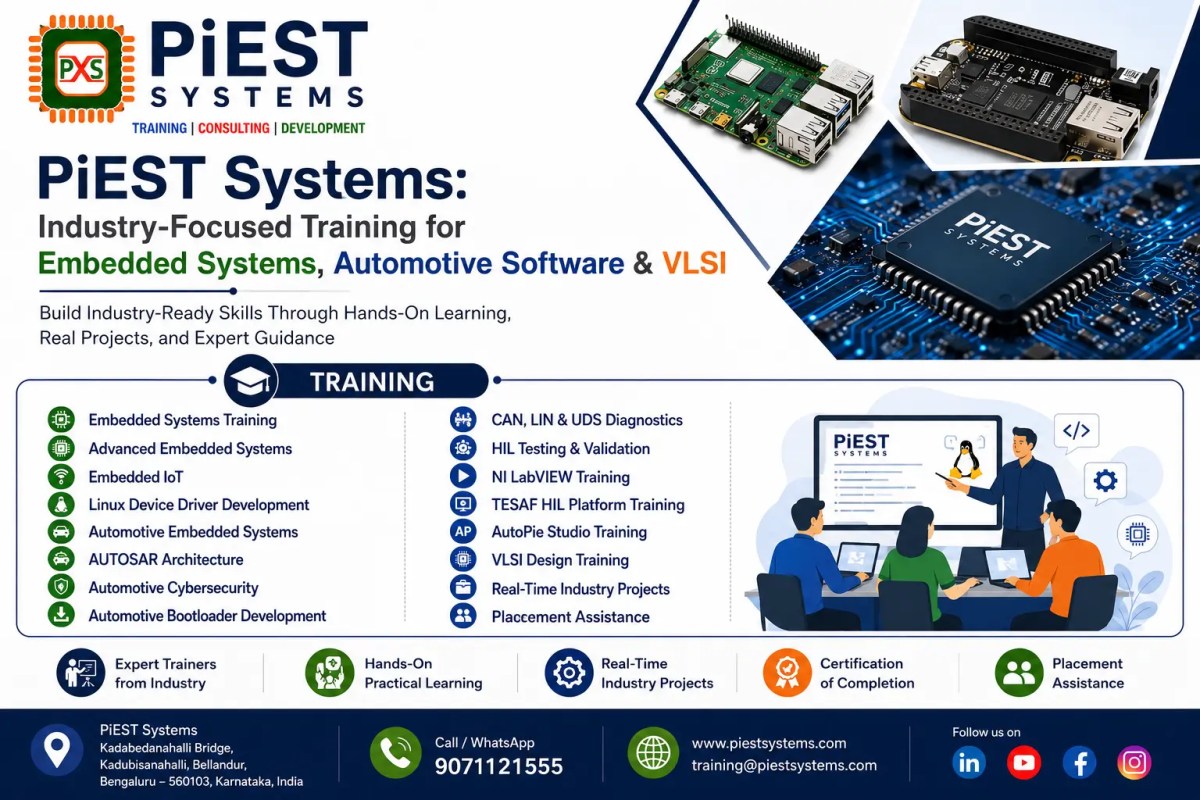
Embedded systems and VLSI sit at the heart of every electronic product you interact with daily – from the processor inside your smartphone to the ECU controlling your car’s engine. Both domains are experiencing explosive growth in India as global semiconductor and automotive companies expand their engineering footprints in Bangalore, Hyderabad, and Pune.
This guide introduces you to Piest Systems – who we are, what makes our embedded systems and VLSI courses different, the industry tools we train you on, and why engineers across Bangalore trust us to build careers that matter.
Who Is Piest Systems?
Piest Systems is an industrial training institute based in Bangalore, built around a simple but uncompromising philosophy: engineers learn best by doing, not by watching. Every course we offer in embedded systems and VLSI training is designed and delivered by professionals who have worked on real industry projects – not by trainers reading from textbooks.
Our name has become associated with technical depth in domains that most institutes only cover at a surface level. While many training providers offer broad, generic content across dozens of subjects, Piest Systems has deliberately focused on embedded systems and VLSI courses that go deep into the tools, methodologies, and problem-solving approaches that companies actually use.
This focus is reflected in everything from our automotive embedded curriculum – covering AUTOSAR with our in-house AutoPie Studio platform, HIL testing with NI LabVIEW and TESAF, and CAN protocol training with PCAN – to our growing VLSI design programs that prepare engineers for chip design and verification roles at semiconductor companies.
Why Embedded Systems and VLSI Belong Together
At first glance, embedded systems and VLSI might seem like two separate worlds – one is about writing software for microcontrollers, the other is about designing the silicon chips themselves. But the reality is that these domains are deeply interconnected, and understanding both gives engineers a significant career advantage.
The Connection Between Embedded Systems and VLSI
Every embedded system runs on a chip designed using VLSI principles. The microcontroller in your STM32 board, the processor in your smartphone, and the ECU silicon in your car’s engine control unit are all products of VLSI design – register-transfer level (RTL) design, verification, synthesis, and physical design.
Engineers who understand embedded systems and VLSI together are uniquely positioned to:
- Debug hardware-software integration issues that pure software or pure hardware engineers struggle with
- Optimise firmware for specific silicon architectures by understanding the underlying chip design constraints
- Move fluidly between firmware roles and chip design/verification roles as their careers evolve
- Communicate effectively across teams in semiconductor companies where embedded software teams and chip design teams must collaborate closely
This is precisely why embedded systems and VLSI training delivered by the same institute – with a coherent view of how these domains connect – gives students a more complete picture than learning each in isolation from unrelated providers.
Embedded Systems Expertise at Piest Systems
Our embedded systems and VLSI courses in the embedded domain cover the full spectrum — from foundational microcontroller programming to advanced automotive specialisations that are in critically short supply across India’s automotive industry.
Advanced Embedded Systems Training (AEST)
Our flagship foundation course covers C programming, ARM/STM32 microcontroller architecture, RTOS concepts with FreeRTOS, and communication protocols – built using Keil and STM32CubeIDE on real STM32 hardware. This is the entry point for ECE/EEE graduates, career switchers, and anyone building a foundation before specialising further.
Automotive Embedded and AUTOSAR
Automotive embedded systems represent one of the fastest-growing segments of India’s engineering job market. Our AUTOSAR Classic training uses AutoPie Studio – Piest Systems’ in-house AUTOSAR configuration platform – giving trainees hands-on BSW module configuration, RTE generation, and SWC integration experience that directly mirrors what automotive OEMs and Tier-1 suppliers expect.
HIL Testing
Hardware-in-the-Loop testing is one of the most specialised and well-compensated skills in automotive embedded engineering. Piest Systems’ HIL Testing course uses NI LabVIEW, TESAF (our in-house test automation framework), and real dSPACE hardware – giving trainees genuine ECU validation experience.
CAN Protocol and Automotive Communication
Every automotive ECU communicates over CAN bus. Our CAN Protocol training uses PCAN hardware for live bus monitoring, message transmission, and CAN FD analysis – the foundational skill for any automotive embedded career.
Bootloader Development
Bootloader engineering is a rare, high-value specialisation. Our Bootloader Development course covers ARM and STM32 bootloader design, UDS-based ECU flashing using PCAN, and OTA firmware update architecture —-built on real STM32 hardware with Keil MDK.
Embedded IoT
For engineers building connected products, our Embedded IoT course covers ESP32 and STM32 platforms, FreeRTOS-based multi-task firmware, MQTT cloud connectivity, and structured validation using TESAF.
Linux Device Driver Training
For engineers targeting the highest-paying embedded specialisation in India, our Linux Device Driver training covers kernel module development, GPIO/I2C/SPI drivers, device tree configuration, and the Yocto Project build system on real Raspberry Pi and BeagleBone hardware.
VLSI Expertise at Piest Systems
While embedded systems focuses on programming the chip, VLSI (Very Large Scale Integration) focuses on designing the chip itself. As one of the best embedded VLSI institute options for engineers in Bangalore, Piest Systems extends its hands-on, project-based training philosophy into the VLSI domain – preparing students for roles in digital design, verification, and the broader semiconductor ecosystem.
Why VLSI Matters in India’s Engineering Landscape
India has become one of the most important global hubs for semiconductor design. Major chip companies – and an increasing number of homegrown semiconductor initiatives – are expanding their India design centres rapidly. This expansion has created sustained demand for engineers trained in:
- RTL Design – Writing hardware description code (Verilog/VHDL) that describes digital circuit behaviour
- Functional Verification – Testing chip designs through simulation before they are manufactured, ensuring designs work correctly before committing to expensive silicon fabrication
- Digital Design Fundamentals – Combinational and sequential logic design, finite state machines, and timing analysis
- ASIC and FPGA Design Flows – Understanding how designs move from concept through synthesis, place-and-route, and into working silicon or programmable logic
How VLSI Connects to Embedded Careers
For students deciding between embedded systems and VLSI courses, it is worth understanding that these are not mutually exclusive paths. Many engineers build careers that span both – starting in embedded firmware development and later moving into chip-level verification, or starting in VLSI verification and later moving into embedded systems where deep hardware understanding is a major advantage.
Piest Systems’ approach to embedded systems and VLSI training is designed with this career flexibility in mind – students gain exposure to how the layers connect, rather than learning each domain as an isolated silo.
What Makes Piest Systems Different
In a market crowded with training institutes making similar promises, here is what genuinely sets Piest Systems apart as a provider of embedded systems and VLSI training:
1. In-House Tools Built for Learning
Most institutes simply demonstrate expensive commercial tools that students rarely get meaningful hands-on time with. Piest Systems has invested in building AutoPie Studio – our own AUTOSAR configuration platform – and TESAF, our test automation framework. These tools give every trainee deep, repeated, hands-on practice with the exact workflows used in AUTOSAR configuration and automotive test validation, without the licensing constraints that limit hands-on time at other institutes.
2. Real Hardware, Every Session
From STM32 boards and PCAN CAN bus adapters to dSPACE HIL simulators, ESP32 IoT kits, and Raspberry Pi/BeagleBone Linux boards – Piest Systems training happens on real hardware. Concepts are demonstrated, then immediately practised by every student on physical devices.
3. Industry-Experienced Trainers
Every trainer at Piest Systems has direct industry project experience in the domain they teach – automotive ECU development, HIL test bench design, embedded Linux BSP work, or VLSI design and verification. This means classroom discussions go beyond textbook theory into the practical decisions, trade-offs, and debugging approaches engineers face on real projects.
4. Career-Outcome Focused Curriculum
Every course at Piest Systems is designed backward from career outcomes – what do AUTOSAR engineers, HIL test engineers, and Linux kernel developers actually need to know and demonstrate in interviews? Our embedded systems and VLSI courses are built to close exactly those gaps.
5. Flexible Learning Formats
Both weekday and weekend batches are available for working professionals, and online training is available via pieduet.com for students who cannot attend in-person sessions in Bangalore.
6. Active Placement Support
Piest Systems maintains active connections with automotive OEMs, Tier-1 suppliers, semiconductor companies, IoT product companies, and embedded product firms across Bangalore, Pune, and Chennai – providing resume support, mock interviews, and direct referrals to graduates.
Embedded Systems and VLSI Career Outcomes
Understanding where embedded systems and VLSI courses lead in terms of career outcomes helps students make informed decisions about their training investment.
Embedded Systems Career Paths
Graduates of Piest Systems’ embedded courses move into roles including:
- Embedded Software Engineer – Firmware development for microcontroller-based products
- Automotive Embedded Developer – ECU software development using AUTOSAR
- HIL Test Engineer – ECU validation using HIL methodology and tools like NI LabVIEW and dSPACE
- Firmware/Bootloader Engineer – Low-level bootloader and OTA update development
- IoT Firmware Developer – Connected device firmware on ESP32/STM32 platforms
- Linux Kernel/BSP Engineer – Device driver development for embedded Linux products
VLSI Career Paths
For students pursuing VLSI training institute Bangalore programs at Piest Systems, typical career destinations include:
- RTL Design Engineer – Writing and optimising Verilog/VHDL code for digital circuits
- Verification Engineer – Testing chip designs through simulation and testbench development
- Design-for-Test (DFT) Engineer – Ensuring chip designs can be effectively tested after manufacturing
- Physical Design Engineer – Working on chip layout, place-and-route, and timing closure
Combined Embedded + VLSI Career Advantages
Engineers who pursue embedded systems and VLSI training together – even if they ultimately specialise in one domain – gain a significant advantage in roles that sit at the hardware-software boundary, including:
- SoC Validation Engineer – Validating system-on-chip designs against both hardware specifications and embedded software behaviour
- Embedded Hardware-Software Co-Design Engineer – Optimising firmware and silicon together for performance-critical products
- Technical Pre-Sales / Applications Engineer – Roles at semiconductor companies that require understanding both chip capabilities and how customers will use them in embedded products
Embedded Systems and VLSI Salary Landscape in India
Both domains offer strong earning potential in India’s current job market, with embedded systems generally offering faster entry-level opportunities and VLSI often offering higher ceilings at senior levels in specialised semiconductor roles.
| Career Track | Fresher Salary | Mid-Level (3-6 yrs) | Senior (8+ yrs) |
|---|---|---|---|
| General Embedded Systems | ₹3.5 – ₹6 LPA | ₹10 – ₹16 LPA | ₹20 – ₹30 LPA |
| Automotive Embedded / AUTOSAR | ₹5 – ₹8 LPA | ₹12 – ₹18 LPA | ₹25 – ₹40+ LPA |
| HIL Testing | ₹4 – ₹7 LPA | ₹8 – ₹14 LPA | ₹22 – ₹35+ LPA |
| Linux Kernel / Device Driver | ₹5 – ₹8 LPA | ₹9 – ₹15 LPA | ₹25 – ₹40+ LPA |
| VLSI (RTL / Verification) | ₹4 – ₹7 LPA | ₹10 – ₹16 LPA | ₹22 – ₹35+ LPA |
For a deeper breakdown of how specific skills and specialisations affect compensation, see our complete Embedded Systems Salary India 2025 guide.
How to Choose: Embedded Systems, VLSI, or Both?
A common question from students exploring embedded systems and VLSI courses is simply: where should I start? Here is practical guidance based on common backgrounds and goals:
✅ If you enjoy programming and want faster entry into the job market – Start with embedded systems. The learning curve to first job is generally shorter, and the automotive embedded sector in particular has very high current demand.
✅ If you are fascinated by how chips are actually built and enjoy digital logic – VLSI may be the better starting point, particularly if you are drawn to RTL design, verification, or physical design work.
✅ If you are unsure – Piest Systems recommends starting with our Advanced Embedded Systems Training (AEST) foundation course. It builds the C programming, digital logic, and hardware fundamentals that benefit both paths, while giving you direct exposure to help clarify your preference before committing to a specialisation.
✅ If you want maximum career flexibility – Consider a combined path: complete an embedded foundation course, then add either an automotive specialisation (AUTOSAR, HIL Testing) or a VLSI specialisation depending on which roles interest you most after your foundation training.
Start Your Embedded Systems and VLSI Training Journey with Piest Systems
Choosing the right Embedded Systems and VLSI Training program is important for students and engineers who want to build practical, industry-ready skills. At Piest Systems, our Embedded Systems and VLSI Training approach combines technical fundamentals, real hardware practice, industry tools, project-based learning, and career-oriented guidance.
Our Embedded Systems and VLSI Training programs are designed for engineering students, fresh graduates, and working professionals who want to develop skills in embedded software development, automotive embedded systems, AUTOSAR, HIL testing, microcontrollers, RTL design, verification, and other semiconductor technologies.
Students joining Embedded Systems and VLSI Training in Bangalore at Piest Systems gain practical exposure instead of learning only through theory. Training includes hands-on exercises, real development boards, debugging tools, automotive communication systems, software platforms, and project implementation.
Piest Systems continues to develop its Embedded Systems and VLSI Training curriculum based on the skills expected in automotive, semiconductor, embedded product, IoT, and electronics engineering industries. This allows learners to build a strong technical foundation while preparing for specialised engineering roles.
If you are looking for practical and career-focused Embedded Systems and VLSI Training, explore the training programs available at Piest Systems and choose the learning path that matches your engineering career goals.
Frequently Asked Questions

Discover more from Piest Systems - Embedded Systems Training Institute in Bangalore
Subscribe to get the latest posts sent to your email.

