

Introduction
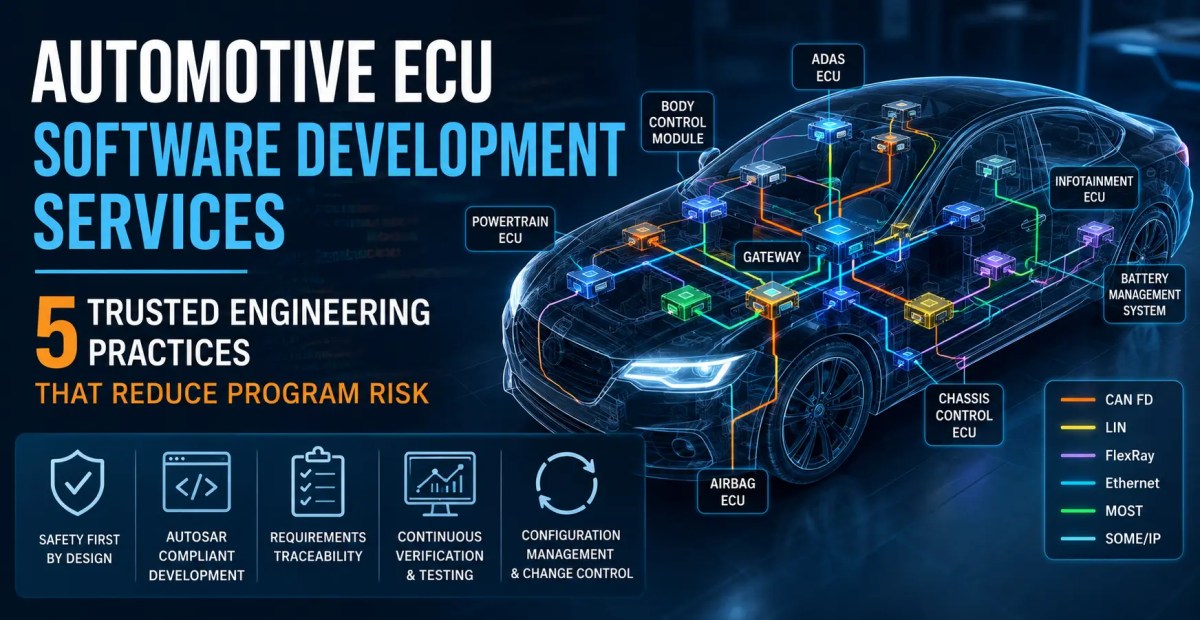
A modern passenger vehicle now runs on more lines of code than many commercial aircraft. Somewhere between 70 and 150 Electronic Control Units communicate constantly across CAN, CAN FD, LIN, FlexRay, and Automotive Ethernet networks, each one responsible for something a driver never sees but always depends on – throttle response, braking coordination, battery management, ADAS decision-making, infotainment stability.
The complexity growth is not gradual anymore. Every new vehicle program adds more software-defined functions, tighter integration between domains, and higher expectations around safety and cybersecurity compliance. For engineering teams at OEMs, Tier-1 suppliers, and automotive startups, this creates a real operational problem: how do you build, integrate, and validate ECU software fast enough to meet program timelines without compromising quality or safety?
This is exactly the problem our Automotive ECU Software Development Services were built to solve. Alongside AUTOSAR Development Services and Hardware-in-the-Loop (HIL) Testing Services, we work with OEMs, Tier-1 and Tier-2 suppliers, EV and autonomous vehicle companies, and semiconductor and industrial embedded organizations that need a dependable engineering partner – not just a staffing vendor.
What separates our automotive ECU software development services from a typical services company is that we don’t rely exclusively on third-party toolchains. Our engineers work with AutoPie Studio, our proprietary AUTOSAR development environment, and TESAF, our in-house automotive test and HIL validation framework. These platforms were built internally, by engineers who have spent years configuring BSW stacks, writing MCAL drivers, and running HIL rigs under program deadlines – which means the tooling reflects real engineering pain points, not theoretical ones.
This article walks through five trusted practices behind our Automotive ECU Software Development Services: why AUTOSAR matters, why testing discipline determines program success or failure, and how proprietary tooling changes the economics of automotive software engineering. If you’d rather skip ahead, our services overview and contact page are one click away.
Table of Contents
- The Real Engineering Challenge Behind Modern ECUs
- Why AUTOSAR Exists – And Why It’s Non-Negotiable Today
- Common Mistakes Companies Make in ECU Software Programs
- Inside AutoPie Studio: How Proprietary Tooling Accelerates AUTOSAR Development
- Why Testing Discipline Determines Program Success
- HIL Testing: Reducing Risk Before Hardware Reaches the Vehicle
- Inside TESAF: Our Automated Test Framework for ECU Validation
- Cybersecurity and Functional Safety: Non-Negotiable Requirements
- The Shift Toward Software-Defined Vehicles
- Where AI Fits Into Automotive Software Validation
- Why Choose Piest Systems
- Frequently Asked Questions
- Conclusion & Next Steps
1. The Real Engineering Challenge Behind Modern ECUs
Every ECU program looks straightforward on a slide: define requirements, write software, integrate, test, ship. In practice, the challenge is coordination at scale. A single body control module might touch dozens of signals across CAN and LIN networks, each governed by a DBC or LDF definition that has to stay synchronized across multiple supplier teams. A powertrain ECU might need microsecond-level timing guarantees while also meeting ASIL-rated safety requirements.
Add UDS diagnostic services, bootloader flashing sequences, and OTA update requirements, and the software stack for even a “simple” ECU becomes a genuinely large embedded system. The complexity isn’t a marketing exaggeration – it’s the reason so many programs slip schedule during integration and validation, the two phases where hidden defects surface.
Engineering teams that treat ECU software as “just embedded C” tend to underestimate the discipline required around configuration management, requirements traceability, and layered architecture. This is where AUTOSAR earns its place in the process.
2. Why AUTOSAR Exists – And Why It’s Non-Negotiable Today
AUTOSAR (AUTomotive Open System ARchitecture, the official standard maintained by the AUTOSAR consortium) exists because the industry needed a way to decouple application software from hardware and basic software layers. Before this layered approach became standard, porting software between ECU generations or microcontroller families meant re-writing large portions of the codebase – expensive, slow, and error-prone. This is why AUTOSAR configuration sits at the center of any serious Automotive ECU Software Development Services engagement.
With a properly configured AUTOSAR Classic Platform stack – RTE, BSW modules, MCAL, and the application layer cleanly separated — a team can reuse validated software components across projects, swap microcontrollers with far less rework, and onboard new engineers faster because the architecture is standardized rather than proprietary to one team’s habits.
For AUTOSAR Adaptive Platform work, particularly relevant to ADAS, connected services, and high-performance computing ECUs, the benefits extend further: dynamic communication, service-oriented architecture, and POSIX-based execution environments that support the kind of continuous software updates modern vehicles increasingly require.
None of this happens automatically just because a team decides to “use AUTOSAR.” Configuration is detailed, tooling-dependent work. RTE generation has to match BSW configuration exactly. MCAL integration has to account for the specific microcontroller’s peripherals. Get any layer wrong and you inherit debugging sessions that eat weeks of schedule.
3. Common Mistakes Companies Make in ECU Software Programs
A few patterns show up repeatedly across automotive software programs, regardless of company size:
Underestimating configuration complexity. Teams new to AUTOSAR often assume BSW configuration is a one-time setup task. In reality, every ECAN routing change, diagnostic service addition, or memory layout adjustment ripples through multiple configuration files that must stay consistent.
Deferring integration testing too long. When integration testing is pushed to the final weeks before a milestone, defects that should have been caught early – signal mapping errors, timing violations, incorrect DTC handling – surface under maximum schedule pressure.
Treating HIL testing as optional or “nice to have.” Some programs rely almost entirely on desk checks and limited bench testing, only discovering environmental or timing-dependent defects after the ECU is already in a vehicle prototype – the most expensive place to find a bug.
Underinvesting in bootloader and diagnostic robustness. Flashing and UDS diagnostic services are frequently treated as an afterthought, yet they are exactly what field service teams depend on when something goes wrong after production.
Ignoring cybersecurity requirements until late in development. Retrofitting security controls into an architecture that wasn’t designed with them from the start is dramatically more expensive than designing for it upfront.
Each of these mistakes is avoidable with the right process discipline and tooling – which is precisely where dedicated Automotive ECU Software Development Services add value beyond simply supplying headcount. See our HIL Testing Services page for how we structure validation to catch these issues early.
Inside AutoPie Studio: How Proprietary Tooling Accelerates AUTOSAR Development
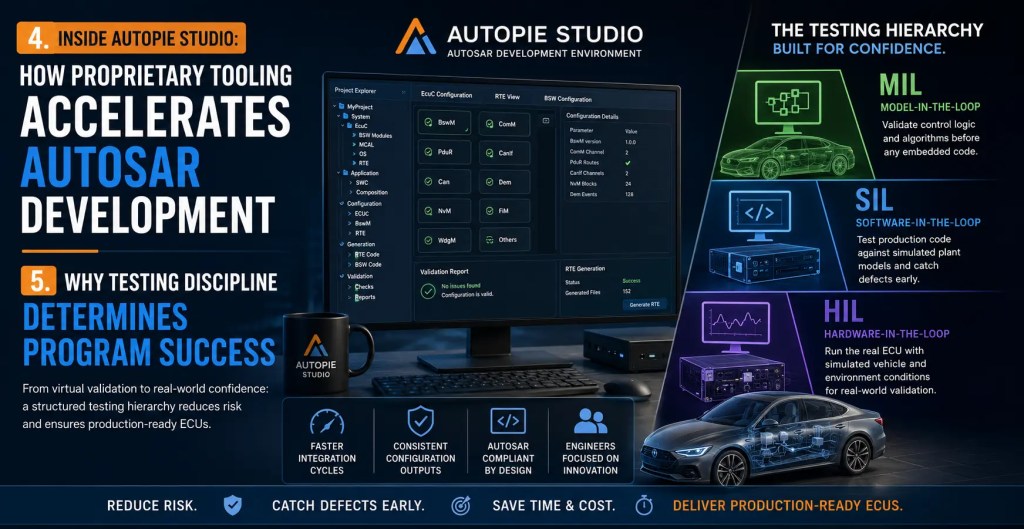
Most automotive software teams rely entirely on external vendor toolchains for AUTOSAR configuration, code generation, and BSW integration. These tools are capable, but they were built as general-purpose platforms serving a wide range of customers – which means engineering teams often spend meaningful time working around workflow friction that isn’t specific to their project.
We took a different approach. Our engineers built AutoPie Studio, an in-house AUTOSAR development environment designed around the actual bottlenecks we experienced running client programs: BSW configuration consistency checking, RTE generation validation, and MCAL integration templates tuned to the microcontroller families we work with most often.
Because AutoPie Studio was built by the same engineers who use it daily, iteration is fast – when a configuration workflow creates friction on a live project, the tool gets refined, not filed as a feature request in someone else’s backlog. This directly translates into shorter integration cycles and fewer configuration-related defects reaching the testing phase.
For clients, the practical benefit is straightforward: faster AUTOSAR development cycles, more consistent configuration outputs across ECU variants, and an engineering team that isn’t fighting its own toolchain to hit milestones.
5. Why Testing Discipline Determines Program Success
Software that compiles and runs on a bench is not the same as software that’s ready for a vehicle. The gap between those two states is where most automotive engineering risk lives – and it’s exactly what our Automotive ECU Software Development Services are designed to close, through a structured testing hierarchy:
- MIL (Model-in-the-Loop): Validating control logic and algorithms before any embedded code exists.
- SIL (Software-in-the-Loop): Testing the actual production code against simulated plant models, catching logic and integration defects early and cheaply.
- HIL (Hardware-in-the-Loop): Running the real ECU against simulated vehicle and environmental conditions – the closest a team can get to real-world validation before physical vehicle testing.
Skipping or shortcutting any of these stages doesn’t eliminate the associated risk – it just moves that risk downstream, where it’s more expensive and more time-consuming to resolve. A defect caught in SIL testing might cost an afternoon. The same defect discovered during vehicle-level testing can cost a program days or weeks, plus the credibility damage of a late-stage failure.
HIL Testing: Reducing Risk Before Hardware Reaches the Vehicle
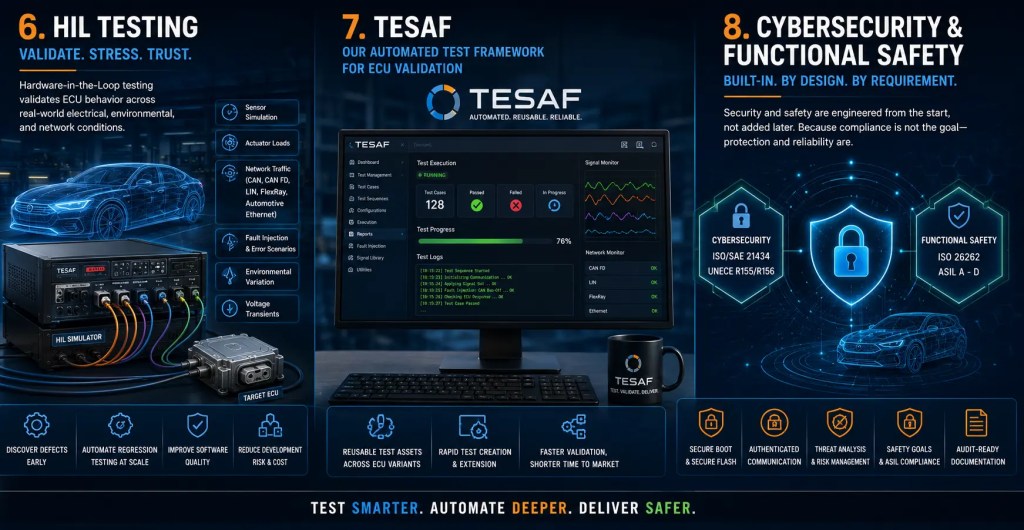
Hardware-in-the-Loop testing exists to answer one question with confidence: does this ECU behave correctly across the full range of real-world electrical, environmental, and network conditions it will encounter in the vehicle – including the edge cases that are difficult or dangerous to reproduce on a test track?
A well-designed HIL rig simulates sensor inputs, actuator loads, network traffic (CAN, CAN FD, LIN, FlexRay, Automotive Ethernet), fault injection scenarios, and environmental variation, all while the actual target ECU runs its production software. This lets validation engineers systematically exercise failure modes – sensor dropout, network bus-off conditions, voltage transients – that would be impractical or unsafe to test on an actual vehicle.
The value isn’t just defect discovery. HIL testing also supports regression testing at scale: once a test suite exists, it can be re-run automatically every time software changes, catching regressions immediately rather than after the next milestone build.
5a. ECU Validation Services as Part of Broader Automotive Embedded Software Development
Testing discipline doesn’t exist in isolation – it’s one piece of a larger discipline that spans the full lifecycle of Automotive Embedded Software Development, from requirements definition through post-launch OTA updates. Treating ECU Validation Services as a standalone checkbox at the end of a program is one of the more common ways teams lose the schedule and quality benefits that structured validation is supposed to deliver.
When ECU Validation Services are planned alongside architecture and BSW configuration decisions – rather than bolted on once code is “feature complete” – validation engineers can build test coverage incrementally, catching defects while they’re still cheap to fix. This is also where Automotive Embedded Software Development teams benefit most from proprietary tooling: a validation framework like TESAF only pays off if it’s integrated early enough to run regression coverage continuously, not introduced as a last-minute gate before a milestone review.
For OEMs and Tier-1 suppliers evaluating ECU Validation Services providers, the question worth asking isn’t just “can you run HIL tests” but “how early in the program can validation start, and how much of it can run automatically.” That answer says more about program risk than almost anything else in a vendor conversation.
7. Inside TESAF: Our Automated Test Framework for ECU Validation
To make HIL and automated testing genuinely efficient rather than a manual, script-heavy bottleneck, our engineers developed TESAF, our proprietary automotive test automation framework.
TESAF was built to address a specific and common frustration: HIL test scripts that are hard to maintain, difficult to reuse across ECU variants, and slow to extend when new requirements arrive mid-program. TESAF standardizes test case structure, signal manipulation, and fault-injection scenarios into a reusable framework, meaning a validation engineer can build out coverage for a new ECU variant by extending existing test assets rather than rewriting scripts from scratch.
In practice, this compresses the time between “software build is ready” and “software build is validated,” which matters enormously on programs where every week of schedule has real cost. It also improves consistency – the same fault-injection and boundary conditions get applied the same way across every test cycle, reducing the chance that a defect slips through because a manual test step was skipped under time pressure.
8. Cybersecurity and Functional Safety: Non-Negotiable Requirements
As vehicles become more connected – OTA updates, telematics, V2X communication – the attack surface for automotive ECUs has grown substantially. Regulatory frameworks like UNECE WP.29 (R155/R156) and standards such as ISO/SAE 21434 now formalize what many engineering teams already understood intuitively: cybersecurity has to be designed into ECU architecture from the start, not bolted on after development.
This means secure bootloader design, authenticated flashing procedures, secure communication protocols, and a documented cybersecurity management process that can withstand an audit. Functional safety, governed by ISO 26262, runs in parallel – ASIL-rated requirements shape everything from software architecture decisions to the depth of testing required for a given function.
Treating these as compliance checkboxes rather than engineering disciplines is one of the more expensive mistakes a program can make. Both require decisions early in the architecture phase that are extremely costly to unwind later.
The Shift Toward Software-Defined Vehicles
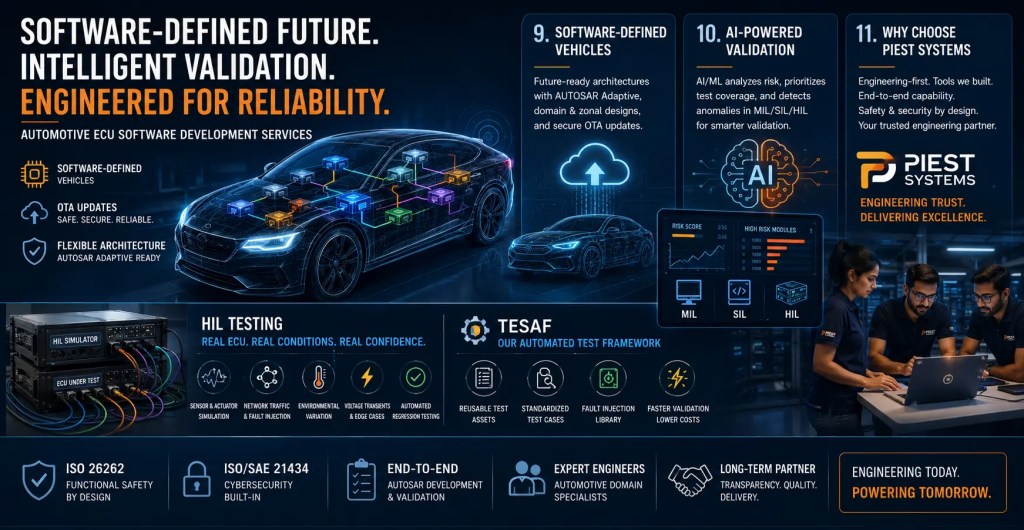
The industry’s center of gravity is moving from hardware-differentiated vehicles to software-defined ones, where features, performance characteristics, and even safety functions can be updated after the vehicle leaves the factory. This shift changes what “done” means for ECU software – it’s no longer a fixed deliverable but a continuously evolving codebase that has to support safe, validated over-the-air updates for years after launch. SAE International publishes ongoing research and standards work tracking this transition, which is worth following for any team scoping a multi-year platform.
This raises the bar for architecture decisions made today. Domain-based and zonal E/E architectures, service-oriented communication, and robust OTA update mechanisms all depend on the AUTOSAR Adaptive foundation being correctly designed from the outset – because retrofitting a software-defined architecture onto a rigid, hardware-tied codebase is far harder than designing for flexibility from day one.
10. Where AI Fits Into Automotive Software Validation
AI is increasingly used inside the validation process itself – not just inside the vehicle’s ADAS stack. Machine learning models can help identify patterns across historical defect data to predict which modules are highest-risk for a given release, prioritize test coverage accordingly, and flag anomalous signal behavior during HIL runs that a rule-based check might miss.
This is a meaningful shift in how validation teams allocate limited testing time: instead of spreading coverage evenly, AI-assisted analysis helps direct deeper scrutiny toward the areas of the codebase statistically most likely to contain defects, based on complexity metrics, change history, and prior defect patterns. Used well, this doesn’t replace structured MIL/SIL/HIL testing – it makes the testing that does happen more targeted and efficient.
11. Why Choose Piest Systems
Piest Systems was built around a simple premise: automotive engineering teams deserve Automotive ECU Software Development Services from a technical partner that understands the deep mechanics of AUTOSAR configuration and ECU validation – not a generalist staffing provider working from a template. Learn more on our About Us page.
- Engineering-first culture. Our team works hands-on with BSW, RTE, MCAL, UDS diagnostics, and bootloader development daily, not occasionally.
- Proprietary tooling. AutoPie Studio and TESAF were built internally by engineers solving their own workflow problems, which means the tooling is shaped by real project pressure, not a generic product roadmap.
- Full-lifecycle capability. From AUTOSAR BSW configuration through MIL/SIL/HIL validation, we support the complete ECU software lifecycle rather than a single narrow slice of it.
- Safety and security by design. ISO 26262 and ISO/SAE 21434 considerations are built into our development process from the architecture phase, not added retroactively.
- Partnership orientation. We work as an extension of your engineering team, with the documentation, traceability, and communication discipline that OEM and Tier-1 programs require.
What is included in Automotive ECU Software Development Services?
Automotive ECU Software Development Services typically span requirements analysis, AUTOSAR BSW configuration, application software development, MCAL integration, RTE generation, diagnostic (UDS) implementation, bootloader development, and supporting documentation for safety and traceability requirements.
What’s the difference between AUTOSAR Classic and AUTOSAR Adaptive?
AUTOSAR Classic Platform is designed for traditional, resource-constrained ECUs handling deterministic real-time functions like powertrain or body control. AUTOSAR Adaptive Platform targets high-performance computing ECUs running dynamic, service-oriented applications such as ADAS and connected vehicle services, typically on POSIX-based operating systems.
Why is HIL testing considered essential rather than optional?
HIL testing allows engineers to validate ECU software against realistic electrical, network, and fault conditions before the vehicle exists in physical form, catching defects – especially timing and fault-handling issues – that are difficult or unsafe to discover during vehicle-level road testing.
How does AutoPie Studio differ from standard AUTOSAR tooling?
AutoPie Studio is Piest Systems’ proprietary AUTOSAR development environment, built internally to address configuration consistency, RTE generation validation, and MCAL integration workflows based on real engineering friction points encountered across client programs.
5. What is TESAF and how does it improve testing efficiency?
TESAF is our proprietary automated test framework for HIL and ECU validation. It standardizes test case structure and fault-injection scenarios into reusable assets, reducing the time and manual effort needed to build out test coverage for new ECU variants or software builds.
How does automotive cybersecurity affect ECU software development?
Standards like ISO/SAE 21434 and regulations such as UNECE WP.29 require cybersecurity considerations — secure boot, authenticated updates, secure communication – to be designed into the ECU architecture from the start, along with a documented cybersecurity management process.
What industries or companies typically need these services?
OEMs, Tier-1 and Tier-2 suppliers, automotive startups, EV manufacturers, autonomous vehicle companies, automotive R&D centers, semiconductor companies, and industrial embedded organizations working on automotive-grade or automotive-adjacent embedded systems.
How long does a typical AUTOSAR ECU software development project take?
Timelines vary significantly based on ECU complexity, the number of communication networks involved, safety classification, and whether the project starts from an existing BSW configuration or from scratch. A scoping discussion is the fastest way to get a realistic estimate for a specific program.
9. Can Piest Systems support an existing in-house engineering team rather than replacing it?
Yes. Many engagements are structured as an extension of an existing engineering team — supporting specific workstreams like BSW configuration, HIL test development, or validation campaigns — rather than a full outsourced replacement.
What communication protocols does Piest Systems have experience with?
Our engineering team works across CAN, CAN FD, LIN, FlexRay, and Automotive Ethernet, covering the network technologies used across body, powertrain, chassis, and increasingly, zonal and domain-based E/E architectures.

Discover more from Piest Systems - Embedded Systems Training Institute in Bangalore
Subscribe to get the latest posts sent to your email.
You must be logged in to post a comment.