
If you are looking for a serious bootloader development course that takes you into one of the most technically demanding and highly paid skills in embedded systems – you are reading the right guide. A structured bootloader development course is the entry point to a category of embedded engineering roles that are chronically understaffed, extremely well compensated, and deeply respected in automotive and product companies alike.
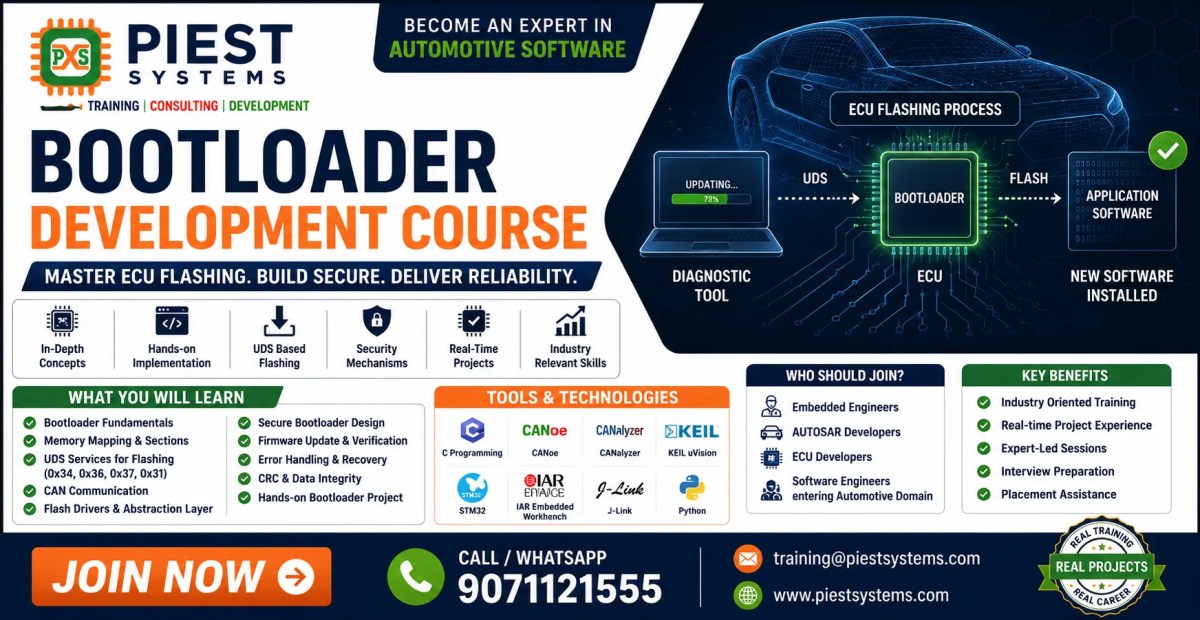
Every electronic device that runs firmware has a bootloader. Your smartphone, your car’s engine ECU, your home router, and the medical monitor in a hospital – all of them rely on bootloader software executing correctly before anything else runs. Engineers who understand how to design, implement, and debug bootloaders are among the most sought-after professionals in the embedded industry.
This complete guide covers everything you need to know -0 what a bootloader is, how it works, ARM and STM32 bootloader design, UDS-based ECU flashing, firmware OTA updates, the tools used in a genuine embedded bootloader training program, and how Piest Systems’ bootloader development course in Bangalore builds the exact skills employers are looking for.
What Is a Bootloader in Embedded Systems?
A bootloader is the very first program that executes on a microcontroller or processor when power is applied. Its job is to initialise the hardware, verify the integrity of the main application firmware, and then hand over control to that application.
Think of the bootloader as the building security guard – it checks credentials before letting anyone through the door. Without a properly functioning bootloader, your main application firmware cannot run reliably, firmware updates cannot be deployed safely, and security vulnerabilities cannot be patched in the field.
Every engineer who enrols in a bootloader development course quickly realises that this seemingly simple concept has enormous depth — startup sequences, memory management, cryptographic signature verification, communication protocol handling, and fault recovery all come together in a bootloader implementation.
How Does a Bootloader Work? Step-by-Step Sequence
Understanding the execution sequence is fundamental to any serious embedded bootloader training program. Here is how a typical custom bootloader operates on an ARM Cortex-M microcontroller:
Step 1 – Power-On Reset and ROM Bootloader
When the microcontroller powers on, the CPU fetches the reset vector from a fixed address in Flash memory. On STM32 microcontrollers, a built-in ROM bootloader (ST’s factory bootloader) is also available and activated by boot pin configuration.
The ROM bootloader can receive firmware over UART, USB, or CAN. For most production systems, however, engineers implement a custom secondary bootloader that gives them full control over the update process – which is precisely what a professional bootloader development course teaches.
Step 2 – Hardware Initialisation
The custom bootloader initialises the minimum required hardware – clock tree, Flash memory controller, communication peripherals (CAN, UART, Ethernet), and watchdog timer. This must happen reliably even in degraded hardware conditions.
Step 3 – Firmware Integrity Check
Before jumping to the application, the bootloader verifies the application firmware using a checksum or cryptographic signature. This step is critical for ARM bootloader development in automotive and industrial applications where corrupt firmware could cause safety issues.
Step 4 – Update Check
The bootloader checks whether a new firmware image is available – via CAN bus, Ethernet, USB, or an internal flag set by the application. If a valid update is present, the bootloader manages the download, erase, and programming sequence.
Step 5 – Jump to Application
Once integrity is confirmed and no update is pending, the bootloader sets the vector table offset register (VTOR), configures the stack pointer, and jumps to the application reset vector. From this point, the application runs as if the bootloader never existed.
Primary vs Secondary Bootloader: What Is the Difference?
A comprehensive embedded bootloader training program covers both types of bootloaders and when each is appropriate:
Primary (ROM) Bootloader
- Stored in factory-programmed read-only memory on the microcontroller
- Cannot be modified by the developer
- Provides basic communication interfaces (UART, USB, CAN) for initial firmware programming
- Examples: STM32 system memory bootloader, NXP ROM bootloader
Secondary (Custom) Bootloader
- Developed by the engineer – this is what a bootloader development course focuses on
- Stored in the first Flash region of the microcontroller
- Fully customisable: supports proprietary protocols, cryptographic verification, dual-bank updates, and rollback
- Can implement UDS diagnostic services for automotive ECU flashing
For any production embedded system – especially in automotive – the custom secondary bootloader is what separates a junior engineer from a truly competent firmware developer. Mastering this is the central goal of any serious ARM bootloader development training.
ARM Bootloader Development: Key Concepts Every Engineer Must Know
ARM bootloader development forms the technical core of any professional bootloader development course. Here are the essential concepts you will master:
Vector Table and VTOR Configuration
The ARM Cortex-M vector table contains the initial stack pointer and exception handler addresses. When the bootloader jumps to the application, it must correctly set the Vector Table Offset Register (VTOR) to point to the application’s vector table address.
Getting this wrong causes hard faults and system crashes – one of the most common mistakes engineers make before taking a structured embedded bootloader training program.
Memory Map Design and Linker Scripts
Every ARM bootloader development project begins with a memory map decision – how much Flash to allocate to the bootloader, the application, and any OTA buffer areas. This is implemented through custom linker scripts in Keil or STM32CubeIDE.
Incorrect linker script configuration causes bootloaders and applications to overlap in memory, which corrupts firmware silently. Understanding linker scripts at a deep level is one of the key skills a bootloader development course delivers.
Dual-Bank Flash Architecture
Modern STM32 microcontrollers support dual-bank Flash – two independent Flash regions that can be read from one bank while writing to the other. This enables zero-downtime firmware updates where the running application is never interrupted during the OTA download phase.
Watchdog Timer Management
The bootloader must service or lock the watchdog timer correctly during firmware download and programming operations. An improperly managed watchdog can reset the MCU mid-flash – leaving the device in an unrecoverable state. Watchdog handling during updates is a critical topic in every serious ARM bootloader development curriculum.
STM32 Bootloader Programming: What You Build in Training
STM32 bootloader programming is the hands-on core of Piest Systems’ bootloader development course. STM32 microcontrollers – particularly the Cortex-M4 and Cortex-M7 families – are the industry standard for automotive and industrial embedded development, making them the perfect platform for bootloader training.
Here is what you will build during STM32 bootloader programming sessions at Piest Systems:
- A custom bootloader from scratch using STM32CubeIDE and Keil MDK
- Flash memory driver – page erase, word write, and CRC verification
- Firmware image validation using 32-bit CRC and magic number headers
- UART-based firmware download protocol for initial flashing
- CAN-based firmware download for automotive ECU flashing scenarios
- Dual-bank OTA update implementation with rollback protection
- Secure bootloader with firmware signature verification (introduction level)
- UDS Service 0x34/0x36/0x37 implementation for diagnostic-based flashing
Each of these exercises directly mirrors real tasks that bootloader engineers perform at automotive OEMs and product companies. Your STM32 bootloader programming portfolio from this training goes directly into your resume.
UDS Flashing in Automotive Bootloader Development
One of the most valuable specialisations in a professional bootloader development course is UDS-based ECU flashing – the method used by every automotive OEM to update ECU firmware in the field.
UDS (Unified Diagnostic Services), defined by ISO 14229, provides a standardised protocol for ECU reprogramming over CAN, LIN, or Ethernet. The bootloader in an automotive ECU must implement specific UDS services to receive, validate, and install new firmware from a diagnostic tester.
The critical UDS services for automotive bootloader reprogramming are:
- 0x10 – DiagnosticSessionControl – Switch the ECU from normal to programming session
- 0x27 – SecurityAccess – Unlock the ECU for reprogramming using seed-key authentication
- 0x34 – RequestDownload – Inform the ECU that a download is about to begin
- 0x36 – TransferData – Send firmware blocks to the ECU in sequential chunks
- 0x37 – RequestTransferExit – Signal the end of the firmware transfer
- 0x31 – RoutineControl – Trigger flash erase and firmware validation routines
In Piest Systems’ bootloader development course, you implement these UDS services in your custom STM32 bootloader. CAN communication is tested and validated using PCAN – giving you direct hands-on experience with the exact tool used in automotive bootloader testing environments.
Understanding UDS flashing is what transforms a general embedded bootloader training graduate into a highly sought-after automotive firmware engineer.
Firmware Update Bootloader Course: OTA and Secure Boot
The firmware update bootloader course content at Piest Systems covers two advanced topics that are increasingly required in modern embedded products:
OTA (Over-The-Air) Firmware Updates
OTA updates allow firmware to be pushed to a device remotely – over Wi-Fi, Cellular, CAN, or Ethernet – without physical access. The bootloader manages the entire OTA lifecycle:
- Downloading the firmware image in the background to the OTA buffer region
- Verifying the image integrity and digital signature
- Scheduling the update for the next power cycle or safe window
- Swapping the new image into the active Flash bank
- Rolling back to the previous firmware if the new image fails to boot
OTA bootloader implementation is one of the most in-demand skills in IoT, automotive, and industrial embedded development right now.
Secure Boot
Secure boot ensures that only authenticated, unmodified firmware can run on the microcontroller. The bootloader verifies the application firmware against a cryptographic signature before jumping to it.
On STM32 platforms, this is implemented using the hardware security features of STM32 Trust Zone-enabled devices – a topic covered in the advanced module of Piest Systems’ firmware update bootloader course.
Tools Used in Our Bootloader Development Course
At Piest Systems, the bootloader development course is entirely hands-on – built around the real tools that embedded engineers use on the job every day.
STM32 Development Boards
Training is conducted on real STM32 Nucleo and Discovery boards – the same hardware families used in automotive and industrial product development. You write code that runs on physical silicon, not simulators.
Keil MDK (Microcontroller Development Kit)
Keil MDK** is the industry-standard ARM development environment used in automotive and industrial embedded projects worldwide. In the bootloader development course, you use Keil MDK for:
- Writing and compiling bootloader firmware in C
- Configuring linker scripts and memory scatter files
- Using the Keil debugger to step through bootloader execution and inspect memory
- Profiling Flash write timing and watchdog behaviour during update sequences
STM32CubeIDE
STM32CubeIDE is ST Microelectronics’ official Eclipse-based IDE for STM32 development. It is used in training for peripheral configuration, HAL-level driver integration, and CubeMX-generated initialisation code that feeds into the bootloader project.
PCAN – CAN Bus Testing and Bootloader Validation
PCAN is used in the automotive bootloader sessions to send UDS diagnostic requests to the STM32 ECU under development. You use PCAN to:
- Send DiagnosticSessionControl (0x10) to switch the ECU into programming mode
- Execute the SecurityAccess (0x27) seed-key exchange
- Transmit firmware blocks using RequestDownload (0x34) and TransferData (0x36)
- Validate the completed flash using RoutineControl (0x31)
This PCAN-based UDS flashing exercise is the single most realistic automotive bootloader session available in any embedded bootloader training program in Bangalore.
Bootloader Development Career Scope in India 2025
A completed bootloader development course opens doors to some of the most technically respected and financially rewarding roles in the embedded industry. Here is why:
High Barrier to Entry: Most embedded engineers have never written a bootloader from scratch. Engineers who have are immediately differentiated in interviews. Hiring managers know this skill requires real hands-on practice – not just theoretical knowledge.
Automotive Demand: Every automotive ECU needs a bootloader – and AUTOSAR-compliant ECUs require UDS-compliant reprogramming bootloaders. The shift toward Software-Defined Vehicles (SDVs) with frequent OTA updates has massively increased demand for bootloader engineers.
IoT Demand: Every IoT product with firmware needs a reliable OTA update mechanism. Bootloader engineers who understand secure OTA design are in very high demand across the consumer electronics and industrial IoT sectors.
Semiconductor and Product Companies: Companies like STMicroelectronics, NXP, Texas Instruments, and Renesas hire engineers who understand their microcontroller bootloader architectures deeply – candidates who have completed a serious firmware update bootloader course are prioritised.
Bootloader Engineer Salary in India 2025
Completing a specialised bootloader development course commands a meaningful salary premium over general embedded engineers:
| Experience Level | Role | Salary Range (LPA) |
|---|---|---|
| 0-1 year (with bootloader training) | Junior Firmware Engineer | ₹4 – ₹7 LPA |
| 1-3 years | Embedded Firmware Developer | ₹7 – ₹12 LPA |
| 3-6 years | Senior Bootloader / Firmware Engineer | ₹12 – ₹20 LPA |
| 6-10 years | Firmware Architect | ₹18 – ₹28 LPA |
| 10+ years | Principal Engineer / Tech Lead | ₹28 – ₹40+ LPA |
Engineers who combine ARM bootloader development skills with AUTOSAR knowledge and UDS protocol expertise are among the highest-compensated embedded professionals in India’s automotive sector, regularly landing roles at Bosch, Continental, KPIT, and Tata Elxsi at the upper end of these ranges.
Who Should Enrol in a Bootloader Development Course?
A professional bootloader development course is the right investment for:
✅ Embedded Software Engineers (0–3 years) – If you have C and microcontroller basics but have never written a bootloader, this is the course that will differentiate you immediately in interviews and salary negotiations.
✅ ECE/EEE Graduates Targeting Firmware Roles – Fresh graduates who complete embedded bootloader training before entering the job market stand out dramatically when applying to automotive OEMs and product companies.
✅ Automotive AUTOSAR Engineers – AUTOSAR reprogramming (UDS flashing) is a direct application of bootloader engineering. An ARM bootloader development background makes you a far more complete AUTOSAR developer.
✅ IoT Engineers – If you are building IoT products, a secure and reliable OTA update mechanism is non-negotiable. The firmware update bootloader course at Piest Systems covers exactly this.
✅ IT Professionals Switching to Embedded – IT professionals with strong C skills can transition into firmware engineering roles with dedicated embedded bootloader training that builds the low-level hardware understanding needed on the job.
✅ Engineers Targeting Product Companies – Bootloader engineering is one of the clearest paths into product-focused embedded companies where compensation and technical depth are both higher than in services firms.
What to Look for in Embedded Bootloader Training
Not all embedded bootloader training programs are equal. Before enrolling, evaluate any program on these criteria:
Real Microcontroller Hardware
A bootloader development course that runs only on simulators is not preparing you for the real job. Look specifically for STM32 or ARM Cortex-M boards as the primary training platform – the same families used in production.
Linker Script and Memory Map Coverage
If a course does not teach linker scripts, scatter files, and Flash memory map design, it is not genuine ARM bootloader development training. This is non-negotiable for real-world competence.
UDS Flashing Exercise
Any automotive-oriented bootloader development course must include a live UDS flashing exercise using real CAN hardware. Piest Systems uses PCAN for this – giving trainees direct experience with production-equivalent tooling.
OTA Update Implementation
Industry-Experienced Trainers
Your trainer must have implemented bootloaders on real hardware in production projects – not just taught from textbooks. Ask about their ARM and STM32 project experience before enrolling.
Bootloader Development Course at Piest Systems, Bangalore
At Piest Systems, our bootloader development course is designed by firmware engineers who have built bootloaders for real automotive and industrial products. Every session is hands-on, every exercise uses real hardware, and every project goes directly into your portfolio.
What You Will Learn
- ARM Cortex-M boot sequence – reset vectors, stack initialisation, and startup code
- STM32 Flash memory architecture – pages, sectors, dual-bank layout
- Custom bootloader design – memory map planning and linker script configuration
- Flash driver implementation – erase, write, and CRC verification routines
- Firmware image validation – CRC32 header checking and magic number verification
- UART-based firmware download protocol
- CAN-based UDS reprogramming – services 0x10, 0x27, 0x34, 0x36, 0x37, 0x31
- OTA firmware update architecture – dual-bank swap and rollback protection
- Watchdog management during firmware update sequences
- Introduction to secure boot and firmware signature verification
- Full bootloader project – end-to-end implementation on real STM32 hardware
Real Tools You Will Use
- STM32 Development Boards – Nucleo and Discovery series for all hands-on exercises
- Keil MDK – ARM industry-standard IDE for bootloader firmware development and debugging
- STM32CubeIDE – For peripheral configuration, HAL integration, and project scaffolding
- PCAN – CAN bus communication for live UDS flashing exercises over CAN
Why Choose Piest Systems for Bootloader Training
- Real STM32 hardware for every trainee – no simulations, no shortcuts
- Keil MDK debugger sessions showing bootloader execution step by step
- Live PCAN-based UDS flashing exercise – the most realistic automotive bootloader session in Bangalore
- OTA update implementation covered in detail – not just mentioned in slides
- Trainers with production firmware project experience on ARM Cortex-M platforms
- Direct pathway to AUTOSAR and Automotive Development courses
- Dedicated placement support for product companies and automotive OEMs
- Both weekday and weekend batches available
- Online training available via pieduet.com
How to Start Your Bootloader Engineering Career: Step-by-Step Roadmap
Here is a practical roadmap for turning your bootloader development course into a full embedded career:
Step 1 – Strengthen Your Embedded C Foundation (Weeks 1–3)
Before bootloader work, you need solid C skills – pointers, memory management, bitwise operations, and function pointers. If these are weak, spend 2–3 weeks on targeted C revision.
Step 2 – Learn ARM Cortex-M Architecture Basics (Weeks 2–4)
Understand the Cortex-M startup sequence, NVIC, clock tree, and Flash controller before writing a single line of bootloader code. This context is covered in the first module of Piest Systems’ bootloader development course.
Step 3 – Enrol in Structured Embedded Bootloader Training (Weeks 5-16)
Choose a program with real STM32 hardware, Keil MDK sessions, and a live UDS flashing exercise. Piest Systems’ bootloader development course covers all of this with a complete end-to-end bootloader project.
Step 4 – Build Your Bootloader Portfolio (Weeks 13–16)
Document your bootloader project – architecture decisions, memory map, Keil debug screenshots, and PCAN UDS flashing logs. This is the kind of portfolio evidence that gets interviews at Bosch, Continental, and KPIT.
Step 5 – Pair with AUTOSAR or CAN Protocol Knowledge
Bootloader engineers who also understand AUTOSAR BSW or CAN protocol architecture are significantly more hireable. Piest Systems provides a clear pathway between the bootloader course and our AUTOSAR and Automotive Development programs.
With focused effort and quality embedded bootloader training, most engineers are interview-ready within 3-4 months of starting the course.
Real-World Applications of Bootloader Development
To appreciate the full scope of ARM bootloader development, here are examples of where bootloaders are critical in real product categories:
- Automotive ECUs – Engine, ABS, and airbag ECUs all use UDS-compliant bootloaders for workshop and OTA reprogramming. ISO 14229 UDS compliance is mandatory for type approval.
- EV Battery Management Systems – BMS controllers use dual-bank OTA bootloaders to receive chemistry parameter updates and algorithm improvements in deployed vehicles.
- Industrial PLCs – Field-deployed PLCs use bootloaders for remote firmware updates without on-site maintenance visits.
- IoT Smart Meters – Electricity and gas meters use encrypted OTA bootloaders with rollback protection to receive tariff and algorithm updates across millions of deployed devices.
- Medical Devices – Infusion pumps and patient monitors use secure bootloaders with FDA-mandated firmware integrity verification.
- Defence and Aerospace – Avionics compute units use DO-178B-compliant bootloaders with cryptographic authentication as a hard safety requirement.
Every one of these industries represents a potential career opportunity for engineers who complete a serious bootloader development course at a program like Piest Systems.
Frequently Asked Questions

Discover more from Piest Systems
Subscribe to get the latest posts sent to your email.